Some days, food doesn’t get cooked. There’s a school run, three errands, a meeting that ran long, and suddenly it’s 3 p.m. and you’ve eaten nothing but coffee.
That’s when most of us reach for whatever’s in the gas station bag rack — and that’s where the trouble starts. Most of those “healthy” snack bars are basically dessert wearing a clean-eating costume.
So I keep a small stash of snacks on the go that I prep ahead. They live in glass jars in the fridge, they travel well, and they save me from the 30-minute hunt for the only “real food” option at the petrol station.
And here’s the rule I follow with every single one of them: protein has to be in it. Not a sprinkle. A real amount. Enough to actually do something.
Protein is what keeps my energy steady, my cravings quiet, and my afternoon from collapsing into a biscuit binge. The formula every snack here follows: protein + fiber + fat. That trio is what stabilizes your blood sugar, tells your fullness hormones (leptin, GLP-1) to do their job, and stops the 3 p.m. crash before it starts. Carbs alone? That’s a blood sugar rollercoaster without a seatbelt.
In midlife it does even more — it protects the muscle we lose faster after our last period, and it tells our hunger signals to behave. Your blood sugar is also less forgiving than it used to be: shifting estrogen makes cortisol twitchier and insulin a bit less responsive, which is why “I’ll just push through” hits so much harder now than it did at 32.
So every recipe below has it built in. (If you’re not sure how much protein you actually need at your age and weight, my Midlife Protein Calculator will tell you in about a minute.)
A small honesty break on protein powders, because this matters. Some protein powders bloat me. Pea did. Whey did too. I landed on rice protein and it agrees with me, finally. I really hate feeling bloated — and judging by my inbox, you do too. So if you’ve tried one type and felt swollen and miserable, try another. Buy the small bag first, never commit to the kilo tub until you know it works for you.
I also have a scoop of collagen in my morning coffee. Quick note on that one, since it gets oversold everywhere: collagen isn’t a complete protein — it’s missing one of the essential amino acids — so it doesn’t replace what your meals need to do. But it’s been good to my skin and nails, and the research on those two backs that up. The hair claims are thinner than the marketing suggests. So I treat collagen as a small daily bonus, not as my real protein source.
Right — here are the five I rotate through. Most take five ingredients or fewer.
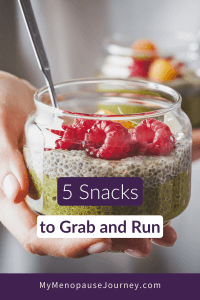
Table of Contents
5 Easy Snacks on the Go Recipes
Each of these takes about 10 minutes hands-on. Most make a batch you can eat from for several days.
1. The Snack Box Formula (One-Container Snacks)
My stepdaughter lives in Australia, and she’s the queen of this one. Long drives are a fact of life over there — and she packs the most beautiful little containers for her kids before they hit the road. Fruit in one section, berries in another, healthy crackers, cut veggies. Everything fresh, everything thought-through. For the kids.
Here’s what struck me watching her do it: we will do this for our kids all day long. We make sure they have real food, that they don’t run out of fuel, that they’re looked after. And then we eat a sad gas-station bar in the front seat.
It’s not childish to make a snack container for yourself. It’s you, finally, thinking about you. So — same idea, grown-up version.
You don’t need a recipe. You need a formula. Grab a glass container with dividers (a Pyrex with sections, a bento box, even a few small jars) and fill it with one of each:
- A protein. Two boiled eggs, or a small handful of cooked shredded chicken, or a scoop of full-fat Greek yogurt.
- A fat. Half an avocado, a few olives, a thumb-sized chunk of feta, or a tablespoon of almond butter.
- Crunch. Cucumber slices, celery, bell pepper, carrot sticks, or a small handful of nuts.
- A little something fresh and sweet. A few berries, some grapes, a couple of dark chocolate squares.
That’s it. Four quadrants. Protein for staying power, fat to keep you full, fibre for your gut, and just enough sweetness so you don’t raid the cookie tin at 4 p.m. Build it the night before. Grab it on your way out the door.
2. My Cacao-Coconut Energy Balls
I went through the energy-balls-on-Pinterest phase too. Half of them have 14 ingredients and you need a food processor that costs more than my first car. This is the version I actually make:
Makes about 12 balls.
- A small handful of pitted dates (about 5–6 Medjool)
- 2 tablespoons coconut oil, softened
- ½ cup shredded coconut (plus a little extra for rolling)
- 2 tablespoons real cacao powder (the good stuff — not cocoa)
- A small handful of oats
- 1 scoop of protein powder (I use rice — use whichever one doesn’t bloat you)
- Optional power-ups: a teaspoon of matcha, a tablespoon of hemp seeds, or any nourishing powder you have in the cupboard
Pulse the dates in a food processor until they form a sticky paste. Add everything else and pulse again until it comes together. Roll into balls with damp hands (otherwise everything sticks to your fingers). Roll in extra shredded coconut to finish. Pop them in the fridge for an hour to firm up.
They keep about 5 days in the fridge or a month in the freezer. Two at a time is plenty — dates are still sugar, even when they’re “natural sugar.” I tend to grab them before a long walk or on a day I know I’m fasting later.
A small bone-health detour worth knowing. If bones are on your mind in midlife (and they should be — we lose density fastest in the first few years after our last period), the dried fruit with the real research behind it is actually prunes, not dates. Multiple trials have shown 5–6 prunes a day can help slow bone loss in postmenopausal women. Dates are lovely — but if you want a sweet midlife treat that’s actively doing something for your skeleton, keep a small bag of prunes in the freezer for that 4 p.m. moment. Frozen, they taste like sweets.
3. Savory Snack Jar
For the days you want savory, not sweet. (Most of mine, honestly.)
I keep a small wide-mouth jar in the fridge and layer it like a quick Mediterranean snack:
- A small handful of olives (kalamata or green — your call)
- Half a sliced cucumber
- A boiled egg, halved
- A small handful of walnuts or almonds
- Optional: a few cubes of feta, a slice of smoked salmon, or some hummus on the side
No recipe, really — it’s an assembly job. Eat it cold straight from the jar with a fork. It travels beautifully in an insulated bag and tastes like a tiny vacation lunch even when you’re eating it at your desk.
4. Avocado-Berry Smoothie in a Thermos
The smoothie I make when I know I won’t see real food until evening. Avocado does the heavy lifting — it’s what makes the smoothie stay with you instead of leaving you hungry an hour later.
Makes 1 large or 2 small thermos servings.
- Half an avocado
- A small handful of frozen blueberries
- A small handful of spinach (you won’t taste it, I promise)
- 1 cup coconut milk or almond milk
- 1 scoop clean protein powder, vanilla if you can get it (or a tablespoon of almond butter)
Blend until creamy. Pour into a thermos or a glass jar with a tight lid. Done. It stays drinkable for about 4 hours if it’s been chilled — past that the avocado starts to go a bit grey, which is harmless but not pretty.
The healthy fats in the avocado plus the protein keep this from spiking your blood sugar the way most smoothies do.
5. Overnight Chia Pudding in a Jar
I know — chia pudding turns up everywhere, including in my Healthy Snacks article. The difference here? The jar. Make it the night before, screw the lid on, throw it in your bag with a spoon. No bowl, no rinsing, no fuss.
Makes 1 jar.
- 3 tablespoons chia seeds
- 1 cup coconut milk (or any milk you like)
- 1 scoop of protein powder (vanilla is loveliest here, but unflavoured works too) or 2 tablespoons of full-fat Greek yogurt stirred in at serving
- 1 teaspoon vanilla extract
- A small handful of berries (fresh or frozen)
- Optional: a teaspoon of maple syrup if you need it sweeter, a sprinkle of cinnamon, or a tablespoon of hemp seeds on top for extra protein and crunch
Add chia, milk, protein powder and vanilla to a small jar. Shake hard for 10 seconds. Wait 5 minutes, shake again (this stops the chia from clumping at the bottom — the trick most recipes forget to tell you). Top with berries. Lid on, fridge overnight. (If you went the Greek yogurt route, skip the powder in the jar and swirl the yogurt in just before eating.)
Eat it cold in the morning, on a break at work, or as a 4 p.m. rescue when nothing else sounds right. With the protein in there, this one carries you for hours — not the 30-minutes-later-hungry chia pudding most recipes leave you with.
A Few Honest Tips Before You Start Prepping
- Sunday is great, but it’s not the only day. Pick a quiet hour anywhere in your week. Mine sometimes ends up being Tuesday evening with a podcast on.
- Glass jars beat plastic. Less leaching, less smell-transfer, and your food just looks nicer — which weirdly makes you more likely to eat it.
- Don’t prep everything at once. Two of these recipes for the week is plenty. Five at a time gets overwhelming, and half of it gets pushed to the back of the fridge to die quietly.
- Ask yourself first: “Am I hungry — or am I tired, stressed, or overstimulated?” Half the time the answer isn’t food. Water, a 5-minute walk, or sitting down with a real cup of tea will do what a snack can’t. The other half — you really are hungry, and one of these recipes is waiting.
- A note for the histamine-sensitive among us. If you tend to get flushing, headaches, or restless sleep from leftovers, you’re not imagining it — midlife often turns up the histamine dial. The recipes here are fine fresh; just don’t push the storage limits. Eat within a day or two and you’re golden. Old leftovers, aged cheese, and last week’s batch-cook are usually the culprits, not freshly-prepped snacks.
- If bones are on your mind, work prunes in too. A handful a day is one of the few food interventions with real bone-density research behind it for postmenopausal women.
- Pair with intermittent fasting if you’re doing it. These are all eating-window-friendly — protein + fat + fibre, no sugar bombs.
If you want a wider rotation of midlife-friendly recipes — for breakfast, lunch, dinner, and yes more snacks like these — that’s exactly what’s inside the Done Guessing: Midlife Weight Loss Bundle for Women Over 45. I put it together because I kept being asked the same question: “What do you actually eat?” The bundle answers that, properly, with the recipes I rotate through myself.
FAQs: Snacks on the Go
Q: How long do these snacks keep in the fridge?
A: The energy balls and chia pudding last about 5 days. The snack boxes and savory jars are best within 2–3 days — boiled eggs and cut veggies don’t love a long fridge life. If you’re histamine-sensitive, lean toward the shorter end of those windows; aged food is the problem, not freshly-prepped.
Q: Can I eat these during an intermittent fasting window?
A: These are eating-window foods, not fasting-window foods — they all contain calories and will break a fast. But they’re great choices for your first meal after breaking a fast, because the protein and fat make for a gentler re-entry. (If you want a full midlife-friendly fasting framework instead of guessing, FAST.EAT.THRIVE!™ walks you through it.)
Q: What’s the best snack to bring on a long car drive?
A: The energy balls travel best — they don’t need refrigeration for a few hours and they don’t make a mess. The snack box is second-best if you have a cool bag. Skip the smoothie for car trips longer than 4 hours.
Q: How much protein should be in a midlife snack?
A: Most midlife women I work with do well with 15–25g of protein per snack — enough to actually steady your blood sugar and quiet cravings, not just a sprinkle. The exact amount you need depends on your weight, activity, and stage of menopause; my Midlife Protein Calculator works out your number in about a minute.
Q: Which protein powder do you recommend?
A: The honest answer: the one your body tolerates. I tried pea (bloat). I tried whey (bloat). I landed on rice protein and finally felt good. Yours might be different — buy the small bag first. Look for clean ingredients, no artificial sweeteners, and ideally something tested for heavy metals. If a powder leaves you puffy or windy, that’s not the right one for you, no matter how many influencers swear by it.
Q: Are these recipes okay if I’m dairy-free?
A: Mostly yes. Skip the Greek yogurt and feta in the snack box (substitute hummus or extra avocado), and use coconut or almond milk in the chia pudding and smoothie. For protein powder, rice or pea-based options are dairy-free. Everything else is naturally dairy-free.
References:
Improving your eating habits – Cleveland Clinic (my.clevelandclinic.org)
Dietary protein and satiety in midlife women – PubMed Central (pmc.ncbi.nlm.nih.gov)
Comparative effects of dried plum on bone in postmenopausal women – PubMed Central (pmc.ncbi.nlm.nih.gov)
Histamine intolerance and the female hormonal cycle – PubMed Central (pmc.ncbi.nlm.nih.gov)

Written by Gita — Certified Fasting Therapist, Nutrition Coach and Keto Coach, and founder of My Menopause Journey since 2014. Every article is built on published research and trusted health sources, updated regularly, and shaped by her own journey through menopause. Read more about Gita and her credentials.