Let’s talk about food and menopause — because wow, it changes the rules on you.
One day you’re cruising along with your usual snacks (hello, toast and a little something sweet at 3pm). The next? They leave you bloated, flat, or wondering when that extra inch showed up around your middle.
Been there.
That’s how I stumbled onto one of the simplest upgrades I’ve found in midlife: seeds. Yes — those tiny things you sprinkled on a smoothie once and then forgot in the back of the cupboard.
Turns out the best seeds for menopause are quietly some of the most useful food on your shelf. They’re crunchy, they go on anything, and they’re packed with the stuff our midlife bodies actually ask for: fiber, plant protein, omega-3 fats, and gentle plant compounds called lignans. Not a magic fix — nothing is. But a small, steady habit that adds up.
Quick answer: are seeds good for menopause? Yes. Seeds give you fiber, plant-based omega-3s, protein, and phytoestrogens — nutrients that support steadier hormones, calmer digestion, and more even energy through midlife. A spoonful or two a day is plenty.
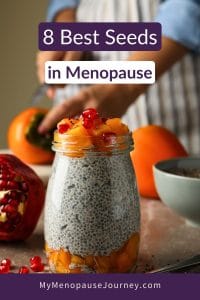
Table of Contents
How the Best Seeds for Menopause Help Your Hormones
Here’s the simple version.
Some seeds — flax and sesame especially — are rich in lignans. Lignans are plant compounds that act like a very gentle, very mild version of estrogen. Think a soft nudge, not a switch. They don’t pump your hormones up or force anything — they seem to help your body handle the estrogen it already has a little more smoothly.
Here’s the part most articles skip: lignans only do their thing once your gut bacteria get hold of them. Friendly bugs in your colon turn flax and sesame lignans into a compound called enterolactone — and that’s the bit linked to steadier blood pressure and heart health. So the benefit isn’t just what you eat; it’s what your gut does with it. One more reason to look after those bacteria with fermented foods and fiber.
And the fiber matters too. Estrogen that’s done its job gets packaged up and sent out through your gut. If things are sluggish down there, some of it can get reabsorbed — so seed fiber helps keep that exit route moving (which is also why seeds are kind to bloating once your body adjusts).
Day to day, what does it add up to? Plenty of women find a daily seed habit helps with the everyday stuff of midlife — hot flashes and night sweats, mood dips, low energy and brain fog, the weight that likes to settle around the middle, drier skin and thinning hair. Not a cure for any of it. Just gentle, useful support — the kind that works best right alongside sleep, movement, and a bit more grace with yourself.
What About “Seed Cycling”?
You’ve probably seen this one doing the rounds. Seed cycling (or “seed rotation”) means eating one pair of seeds in the first half of your cycle and a different pair in the second:
- First half (days 1–14): ground flax + pumpkin seeds
- Second half (days 15–28): sunflower + sesame seeds
The idea is that each pair “supports” a different hormone phase. It’s a lovely, tidy theory.
Here’s the honest bit: the rotation schedule itself hasn’t been shown to balance hormones — especially in menopause, where there’s no monthly cycle to follow anyway. Most of the research is small and on younger women with PMS or PCOS, and even there it’s early days.
So should you bother? If the rhythm of it appeals to you, go right ahead — it’s cheap, it’s harmless, and you’ll be eating a great mix of seeds either way. If “no period to track” makes it feel pointless (fair), don’t sweat the calendar. The real win isn’t the schedule. It’s simply eating a variety of seeds, most days. That you can do without a chart on the fridge.
The 8 Best Seeds for Menopause (and Why)
Here’s my midlife seed lineup — what each one brings, and the little thing worth knowing about it.
1. Flaxseed — the lignan queen
Flaxseed is the big one for hormones: the richest food source of lignans we’ve got. It earns its keep beyond hormones, too — in one study of people with high blood pressure, about 30g of ground flax a day brought their numbers down by one of the largest amounts ever recorded from a single food. Two things to know: eat it ground, because whole flaxseeds sail straight through you undigested — and flax oil is lovely for omega-3s but has none of the lignans (those live in the fiber, which gets pressed out). Here’s the full flaxseed rundown.
2. Chia seeds — your gut’s best friend
Chia is a big, gentle hit of fiber that swells into a gel, keeps you full, feeds good bacteria, and helps everything move along. Its omega-3 is ALA — the plant kind — which is good to have, though your body converts only a little of it into the active forms, so treat chia as a helper alongside oily fish or an algae oil, not a swap for them. One safety note worth its weight in gold: never eat chia dry. It can swell in your throat — there’s a documented ER case of dry chia blocking a man’s esophagus. Always soak it first; 10–15 minutes does it. More on chia here.
3. Pumpkin seeds — for sleep & mood
Pumpkin seeds are my pick when nights are rough. They’re loaded with magnesium and zinc, plus tryptophan — the building block your body uses to make calm-and-sleepy serotonin and melatonin. A small handful in the evening is a quiet little nudge toward better rest. In one small trial, postmenopausal women taking pumpkin seed oil saw better “good” cholesterol, slightly lower blood pressure, and easier hot flashes and joint aches. Bonus support for thyroid and immune health too.
4. Sunflower seeds — skin soothers
Sunflower seeds bring vitamin E and selenium — good for skin and for mopping up everyday wear and tear. One honest caveat: they’re high in omega-6, which most of us already get plenty of. Keep these to a sprinkle rather than the star of the show.
5. Sesame seeds — the other lignan star
Sesame (and tahini — my kitchen shortcut) is the other big lignan source. In a small study, postmenopausal women eating sesame daily for five weeks saw better cholesterol, better antioxidant status, and a friendly shift in how their bodies handled estrogen. Same trick as flax: your gut turns sesame’s lignan into that very same enterolactone. It’s rich in calcium, too — handy when bones need the backup.
6. Hemp hearts — the protein pick
Hemp hearts are the protein star of the lineup. They’re a complete protein — all nine essential amino acids — with about 10 grams in three tablespoons (more than an egg), per Cleveland Clinic. They carry a tidy omega-3-to-omega-6 ratio and GLA, an anti-inflammatory fat that’s kind to skin and achy joints. Honest note: hemp’s a little low in a couple of amino acids (lysine and leucine), so it’s a brilliant add-on rather than your only protein — pair it with the rest of your day’s protein.
7. Poppy seeds — tiny bone helpers
Poppy seeds are little bone-friends: good calcium, phosphorus, and magnesium, plus fiber. Fun (and true) fact — eat a big spoonful and you could in theory flag a drug test for opiates. The poppy-seed muffin amount on your plate? Completely fine.
8. Pomegranate seeds — the antioxidant treat
Pomegranate seeds (the juicy arils) are more fruit than seed, really — but they’re full of polyphenols and vitamin C for circulation, collagen, and a bit of glow. Your gut bacteria even turn their polyphenols into a compound called urolithin A, which researchers are looking at for cell health and aging. Scatter them on anything that needs a jewel-bright lift.
One More Worth Knowing: Black Seed
Here’s the dark horse most seed lists skip. Black seed — also called black cumin or Nigella sativa, the little black specks you’ve seen on naan and in dukkah — has more menopause-specific research behind it than you’d expect. In small trials, menopausal women taking it for a couple of months saw improvements in cholesterol and blood sugar, and one study using the oil reported easier menopausal symptoms.
Two honest caveats: the studies are small, and they mostly used black seed as a powder, capsule, or oil rather than a sprinkle — and the cholesterol benefit faded once women stopped. So think of it as a worth-a-try addition, not a daily must. A pinch on flatbread or roasted veg is a lovely, peppery place to start.
Easy Ways to Eat More Seeds
This is where seeds shine — no complicated prep needed.
- Overnight chia pudding — stir 3 tbsp chia into almond or coconut milk, add a drop of vanilla, leave it overnight, top with berries. (Soaked = safe — see the note below.)
- A seed-sprinkle jar — keep a mix of flax, sesame, sunflower, and hemp by the kettle. Sprinkle on salads, soups, or yogurt.
- Pumpkin seed butter — blend roasted pumpkin seeds until creamy; spread on apple slices for a steady-energy snack.
- Tahini dressing — whisk tahini with lemon, garlic, and water until smooth; drizzle over roasted veg.
- Homemade seed crackers — mix flax, chia, sesame, and pumpkin seeds with water, salt, and spices; bake until crisp. Lovely with guacamole.
- Pomegranate scatter — toss the arils over salads or chia pudding for a sweet, tangy hit.
My tip: rotate them through the week — not for any strict rule, just so your body gets the full spread of nutrients.
A Few Things to Keep in Mind
- Start slow. Seeds are high in fiber, so build up gradually — too much too fast means bloating.
- Drink water. Fiber needs fluid to do its job.
- Soak your chia, never eat it dry. (See above — it really can swell and stick.)
- Grind your flax. Whole seeds pass straight through; ground means you actually absorb the good stuff.
- Gentle on histamine. If you react to histamine-rich foods, good news — flax, chia, and hemp are generally among the best-tolerated, low-histamine seeds, so they’re an easy place to start.
- Choose organic where you can. Seeds can be heavily sprayed, so organic is worth it when the budget allows.
- Watch portions. Seeds are nutrient-dense — a couple of spoonfuls a day is plenty.
Not sure which of your symptoms are even hormone-related anymore? Start here. My free guide — What Is Happening to Me? A 5-Minute Menopause Map — sorts it out in five minutes flat. No overwhelm, just a clear picture of what’s going on and the first place to put your energy.
FAQ: Seeds and Menopause
Which seeds are best for menopause?
Flax, chia, pumpkin, sunflower, sesame, hemp, poppy, and pomegranate — each brings something different, from lignans to magnesium to protein.
Do seeds really balance hormones?
They help. The lignans, omega-3s, fiber, and minerals support how your body handles its hormones — gently, not dramatically. Don’t expect a switch-flip; do expect steady support.
Is seed cycling worth it in menopause?
It’s harmless and cheap, but the schedule itself isn’t proven — and with no monthly cycle to follow, it’s optional. A daily variety of seeds matters far more than the calendar.
Can I eat seeds every day?
Yes — a couple of spoonfuls of mixed seeds daily is a lovely habit. Start small and build up.
What’s the easiest way to start?
A jar of mixed seeds by the kettle. Sprinkle it on whatever you’re already eating.
References:
Potent antihypertensive action of dietary flaxseed in hypertensive patients – Hypertension (www.ahajournals.org)
Flaxseed consumption may reduce blood pressure: a systematic review and meta-analysis – The Journal of Nutrition (jn.nutrition.org)
Enterolactone, lignans and blood pressure (NHANES) – PMC (pmc.ncbi.nlm.nih.gov)
Sesame ingestion affects sex hormones, antioxidant status and blood lipids in postmenopausal women – The Journal of Nutrition (pubmed.ncbi.nlm.nih.gov)
Hemp seed benefits – Cleveland Clinic (health.clevelandclinic.org)
Chia seeds – Harvard T.H. Chan School of Public Health (nutritionsource.hsph.harvard.edu)
Esophageal impaction with chia seeds – American College of Gastroenterology (gi.org)
Nigella sativa seed powder and lipids in menopausal women – Journal of Translational Medicine (pubmed.ncbi.nlm.nih.gov)
Efficacy of seed cycling for PMS and PCOS: a systematic review – PMC (pmc.ncbi.nlm.nih.gov)

Written by Gita — Certified Fasting Therapist, Nutrition Coach and Keto Coach, and founder of My Menopause Journey since 2014. Every article is built on published research and trusted health sources, updated regularly, and shaped by her own journey through menopause. Read more about Gita and her credentials.