A few years ago, bone broth went from “the stock my grandmother simmered on the back of the stove” to a seven-dollar wellness elixir in a paper cup.
Suddenly it was going to firm your skin, heal your gut, rescue your bones, and basically turn back time.
So let’s have an honest, woman-to-woman chat about bone broth benefits — what this cozy old-fashioned mug really does for you in midlife, and what’s just clever marketing. There’s a lovely, true middle ground, I promise.
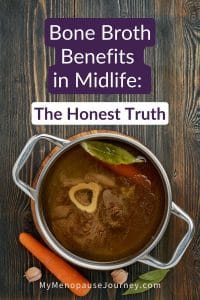
Table of Contents
What bone broth actually is
It’s simple, really. You simmer animal bones and the bits attached to them — joints, skin, cartilage — in water for a good long while, often with a splash of vinegar. Slowly, they release collagen, gelatin, amino acids, a little protein, and some minerals.
One honest thing up front: what ends up in your mug varies enormously. The bones you use, how long you simmer, whether you add acid — it all changes how much “good stuff” you actually get. A slow homemade brew and a watery supermarket carton are not the same drink.
The real bone broth benefits
Here’s what bone broth genuinely brings to the table — the real bone broth benefits, minus the magic-wand promises.
Cozy, easy nourishment
A warm mug is hydrating, comforting, and gently satisfying — no small thing on a day when your appetite’s low or you’re feeling under the weather. It carries some protein, too: roughly 6 to 10 grams a cup, mostly from collagen.
One honest note: that protein isn’t “complete” — it’s low in the building blocks (the BCAAs) your midlife muscles need most. So enjoy broth as a lovely addition, but lean on eggs, fish, dairy, beans and meat for your real protein needs.
Collagen — with an honest asterisk
Bone broth does contain collagen, and collagen is the scaffolding for your skin, joints and bones — all of which get a little needier after menopause. So far, so good.
The asterisk: most broths don’t hold nearly as much collagen as the concentrated collagen peptide powders used in the studies on firmer skin and easier joints. So if collagen is your goal, broth is a gentle bonus, not the main event — peptides plus a good diet (plenty of protein and vitamin C) are the reliable route, as Harvard’s nutrition team lays out. Enjoy the broth for the comfort; don’t count on it to remodel your face.
A calming wind-down
Bone broth is rich in glycine, an amino acid with a quietly calming reputation. I won’t promise it’ll knock you out — but a warm, savory mug in the evening is a soothing little ritual, and a kinder bedtime habit than a glass of wine or a scroll through your phone when sleep‘s being difficult.
Gut comfort
Warm, easy to digest, gentle on a cranky stomach — broth has been the “feel-better” food for generations, and there’s something to that. The amino acids in it (like glutamine) are part of what your gut lining is built from. Just know the popular “heals leaky gut” line runs ahead of the evidence — so think soothing comfort, not cure.
Let’s bust a few bone broth myths
This is where the loudest bone broth benefits get ahead of themselves. A few gentle corrections:
- “It detoxes you.” It doesn’t — your liver and kidneys handle that, beautifully, every single day. Broth is nourishing, not a cleanse.
- “It balances your hormones.” No evidence for this one. Lovely food, but it isn’t doing a thing to your estrogen.
- “It’s packed with calcium for your bones.” This is the big one — and it’s not true. Bone broth holds very little calcium or magnesium (under 5% of a day’s needs per cup). For your bones, what truly matters is enough calcium and vitamin D, plenty of protein, and strength training — not a daily mug of broth.
A few honest safety notes
Bone broth is safe and lovely for most of us. Just a handful of things worth knowing:
- Quality of bones matters. Bones can store traces of lead, and a little can end up in the broth. For most people the amounts are small — but it’s a good reason to use bones from organic or grass-fed sources, and not to treat broth as something to drink by the liter every day. If you’re pregnant or have kidney trouble, keep it occasional.
- Sensitive to histamine? Here’s one a lot of women miss. Because it’s simmered for so long, bone broth tends to be high in histamine — so if you get flushing, headaches, hives, or a racing heart and unsettled tummy after broth (or after wine, aged cheese, and fermented foods), it may not be your friend. The gentler swap is a meat stock: just meat, not bones, simmered for an hour or two from fresh ingredients, then strained and cooled quickly. It’s lower in histamine and often sits much easier — worth knowing, since histamine sensitivity can creep up around menopause.
- Watch the salt. Store-bought broths can be very salty. Read the label, or make your own and salt it yourself.
- It’s not a meal. With its modest, incomplete protein, broth is a supporting act — not your dinner.
How to actually enjoy it
Make your own — bones, water, a splash of vinegar, and a long, low simmer (the vinegar helps pull out the good stuff). Knuckle bones and chicken feet make it especially rich and jiggly.
Sip it as a snack — a warm mug mid-afternoon beats reaching for something sugary.
Use it as a base — for soups, stews, cooking grains, or a pot of vegetables. An easy way to fold it in without making it a whole project.
Buying it? Look for real bones on the ingredient list, decent protein, and not-too-much sodium. Plenty of cartons labeled “bone broth” are really just salty stock.
So, is bone broth worth it in midlife?
Honestly? Yes — as long as you love it for what it actually is.
It’s warm, nourishing, hydrating comfort with a little protein and a gentle dose of collagen. That’s genuinely worth having in your week. Just don’t ask it to firm your jawline, fix your gut, or save your bones single-handedly — those are bigger jobs for a whole way of eating and living.
That’s the real story behind the bone broth benefits: not a miracle in a mug, but a cozy, old-fashioned superfood that’s earned its quiet place at the table.
And if you’re still sorting out which midlife changes are even yours — what’s hormones, what’s just life — my free 5-Minute Menopause Map is a gentle place to start.
References:
Collagen (and bone broth nutrition) – Harvard T.H. Chan, The Nutrition Source (nutritionsource.hsph.harvard.edu)
Is bone broth good for you? – MD Anderson Cancer Center (mdanderson.org)
Bone broth: benefits and risks – Cleveland Clinic (clevelandclinic.org)
Hydrolyzed collagen and skin elasticity (randomized trial) – PMC (pmc.ncbi.nlm.nih.gov)
Collagen peptides and joint pain (review) – PMC (pmc.ncbi.nlm.nih.gov)
Lead contamination in bone broth (study) – PubMed (pubmed.ncbi.nlm.nih.gov)
Histamine intolerance: causes, symptoms and management (review) – PMC (pmc.ncbi.nlm.nih.gov)

Written by Gita — Certified Fasting Therapist, Nutrition Coach and Keto Coach, and founder of My Menopause Journey since 2014. Every article is built on published research and trusted health sources, updated regularly, and shaped by her own journey through menopause. Read more about Gita and her credentials.