
If dry skin in menopause has you wandering the beauty aisle like it owes you money, I get it. I’m always amazed at the endless shelves of creams and serums out there. Each one does have its own claims to be the magic fix for dryness, doesn’t it?
But hey — I’m not here to wag a finger if you’ve got a favorite cream on your nightstand. Rather, I’m here to share something I’ve personally learned while aging:
Healthy, glowing skin doesn’t start in a plastic container.
Sure, as we age, our skin naturally gets thinner, drier, and more sensitive. But slathering chemical-rich creams, layer after layer, isn’t going to fix what’s really happening underneath.
For me, the game-changer was realizing that glowing skin comes from within. Yup, cliché, I know!
But being in midlife taught me to start paying attention to how I fueled my body, how I moved, and how I managed stress. Once I did? My skin began to reflect those changes.
Now when I see a label with a mile-long list of ingredients I can’t pronounce, I just shake my head and think: “Nope, not for me.” Back it goes, and I move on.
So, let’s skip the false promises and talk about what really helps: simple, natural habits that treat your skin from the inside out!
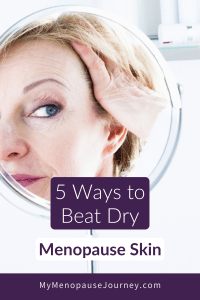
Table of Contents
Why Dry Skin Shows Up in Menopause
Hormones, my friend — they’re the ringleaders in many aspects of midlife wellness, including the health of our skin!
As estrogen and progesterone start to slide, your skin loses some of the oils and collagen that used to keep it supple and bouncy. Without their support, dryness creeps in, and sometimes, it’s more like a full-on desert storm.
And here’s the bit that lands like a thud once you hear it: women can lose up to 30% of their skin collagen in the first five years after menopause, and then around 2% every year after that. That’s not your imagination in the mirror — that’s a real, measurable shift happening under the surface.
Add in a thyroid that’s not always firing, a little stress (okay, maybe a lot), and the fact that we sometimes forget to hydrate — and boom, we’ve got dry, itchy, not-so-happy skin.

Stress, in particular, ramps up cortisol, which can weaken your skin barrier and make it harder for your skin to retain moisture.
Translation? The more stressed you are, the more your skin may feel tight, flaky, or irritated.
But here’s the good news: you don’t have to just “accept it.”
Your skin is resilient and responds beautifully when you give it the right care!
Beyond Dryness: Common Skin Problems in Midlife Women
Here’s an overview of usual skin issues in midlife related to hormonal changes and lifestyle factors. Some of these are also experienced by men in andropause:
1. Thinning Skin
- Cause: Estrogen supports collagen and elastin production. Its decline leads to a loss of skin thickness.
- Symptoms: Skin becomes fragile, bruises easily, and heals slower.
- Seen in both: Men and women, but more pronounced in postmenopausal women.
2. Wrinkles and Sagging
- Cause: Loss of collagen, elastin, and hyaluronic acid due to lower estrogen and testosterone.
- Symptoms: Fine lines, deeper wrinkles, and drooping around the eyes, mouth, and jawline.
3. Acne or Breakouts
- Cause: Fluctuating or declining androgen (male hormone) levels, which can stimulate sebum production.
- Symptoms: Adult-onset acne, especially along the jawline, chin, and neck.
- More common in: Women during perimenopause or menopause.
4. Hyperpigmentation (Age Spots/Melasma)
- Cause: Hormonal changes can trigger melanocyte activity (pigment-producing cells).
- Symptoms: Dark spots, uneven skin tone, or melasma (patchy brown discoloration).
- Triggered by: Sun exposure and hormonal replacement therapy (HRT) in some cases.
5. Increased Sensitivity or Irritation
- Cause: Thinner, drier skin with a compromised skin barrier is more reactive.
- Symptoms: Redness, itching, burning, or flare-ups of conditions like rosacea or eczema.
6. Slow Wound Healing
- Cause: Lower estrogen affects circulation and tissue repair.
- Symptoms: Cuts and abrasions take longer to heal, may scar more easily.
7. Excess Hair or Hair Loss
- Cause: Hormonal imbalances (drop in estrogen or increase in androgen dominance).
- Symptoms: Thinning hair on the scalp, increased facial hair (chin, upper lip). For men in andropause, continued hair thinning or male-pattern baldness progression.
5 Natural Remedies for Dry Skin in Menopause
Dry skin in menopause isn’t just about what’s happening on the surface — it’s your body’s way of telling you it needs more support.
You can bring back the softness and glow by eating skin-loving foods (think salmon, leafy greens, nuts, and bone broth), staying well hydrated, keeping your body moving (to boost circulation), and pampering your skin with nourishing oils (like rosehip, avocado, or jojoba). Adding a daily collagen supplement can also help restore firmness and moisture from the inside out!
So let’s get to the good part — the five small, everyday shifts that actually move the needle.
1. Feed Your Skin From the Inside Out
Our skin is basically a tattletale — it shows exactly how we’re treating ourselves.
When I was filling up on biscuits, cookies, and “just a little” sugar here and there, my skin looked tired and cranky. Once I shifted to real, nourishing food, it completely changed.
Think of these foods as your skin’s besties:
- Fatty fish, like salmon or sardines, for those juicy omega-3s.
- Nuts and seeds — walnuts, pumpkin, chia, and flax — for healthy fats and minerals. (More on the best nuts for midlife and why seeds are a midlife win.)
- Leafy greens and bright veggies for vitamins and antioxidants.
- Avocados and olive oil for that deep, lasting moisture.
- Bone broth for collagen support (plus a cozy, healing hug in a mug).
✅ And here’s the kicker: if you suspect dairy, gluten, or sugar are messing with your skin (they sure did with mine), try a little break. Your skin will let you know if it’s happier without them!
2. Move It, Glow It
Here’s the thing: exercise isn’t just about your waistline or your heart health. It’s about your skin too.
Movement boosts circulation, which means more oxygen and nutrients delivered right where your skin needs them. And yes, a little sweat is a natural detox for your pores.
✅ You don’t need a fancy gym membership. A brisk walk, some yoga stretches, half an hour of strength training, or even dancing while you make dinner — it all counts.
Every step, stretch, or shimmy gets you closer to that natural glow!
3. Oils That Love Women’s Skin
Let’s give your skin something worth drinking in. Your skin isn’t a sponge that soaks up everything you put on it (that “60% absorption” line you’ve probably heard is a myth) — but it is your largest organ, and the better you treat it, the better it treats you back. So why not give it something simple and clean to drink in?
My personal go-tos? Jojoba, argan, sesame, and raspberry seed oils. Yup, I skip the chemical-filled jars and reach for pure, nourishing oils instead. They’re simple, natural, and my skin loves them.
For mature skin (yes, that’s us — and we’ve earned every bit of that word), these oils are absolute gems:
- Rosehip seed oil: packed with omega-3s, slows collagen breakdown, helps new cells thrive.
- Raspberry seed oil: deeply moisturizing and protective, reduces signs of aging.
- Prickly pear seed oil: rich in provitamin A, works on wrinkles, pigmentation, and guards against free radicals.
- Avocado oil: a collagen stimulator, full of omega-7 for moisture and cell regeneration.
- Coconut oil: a body favorite! (I skip it on my face — a bit too heavy there for me.)
✅ My little evening ritual: a quick dry brush to wake up circulation, then massage in one of these oils before a warm shower. And here’s my secret weapon — I always end with a blast of really cold water, especially down the back of my neck. Sounds awful, I know, but the cold lights up your vagus nerve (the long calming nerve that runs down the side of your neck and basically tells your body “okay, you can stand down now”). Lower cortisol, calmer mood, happier skin barrier. Five minutes of pure self-care, and my skin always thanks me for it.
4. Hydrate Like You Mean It
It’s the oldest advice in the book, and also the truest: drink your water.
While tea and coffee have health benefits of their own, nothing beats H2O.
So, if your skin feels tight, itchy, or dull, you might not need a new cream — you might just need a big glass of water. The Cleveland Clinic also points to plain old hydration as one of the simplest, most underrated levers for thirsty skin.
✅ Aim for at least eight glasses a day, and swap sugary sodas for herbal teas or lemon water. Your skin cells will plump up with gratitude.
5. Collagen Support That Works
Along with nourishing foods and natural oils, I’ve found daily collagen to be one of those small daily rituals that really pays back.
It supports elasticity, hydration, and hair and nail strength. For me, blending collagen powder into my coffee or smoothie is an easy ritual for that natural glow!
✅ For optimal skin health, functional medicine experts often recommend hydrolyzed collagen peptides — particularly Type I and III.
Good sources are grass-fed, pasture-raised bovine or wild-caught marine collagen. Pair it with vitamin C and zinc to boost collagen synthesis and skin hydration naturally!
And one quiet reminder: collagen sits on top of overall protein intake. If you’re not eating enough protein day to day, a collagen scoop can only do so much heavy lifting. Not sure where you land? My Midlife Protein Calculator gives you your number in about thirty seconds.
The Bottom Line
Dry skin in menopause doesn’t have to be your new normal. It’s a sign — your body asking for more nourishment, more hydration, more love!
With the right food, movement, natural oils, and plenty of water, your skin can absolutely glow again.
And about those wrinkles? I call them my smile lines and wisdom marks.
They’re proof of a life fully lived! Add a healthy, hydrated glow underneath, and that timeless smile, trust me — you’ll stun everyone in your golden years.
FAQs About Dry Skin in Menopause
Q: Why is my skin so dry in menopause?
A: Hormonal changes reduce estrogen and progesterone, lowering collagen and oil production. Stress, thyroid shifts, and dehydration can make it worse.
Q: What foods help the most?
A: Fatty fish, nuts, seeds, avocados, leafy greens, and bone broth — they hydrate, support collagen, and calm inflammation.
Q: Which oils are best for mature skin?
A: Rosehip seed, raspberry seed, prickly pear seed, avocado, jojoba, and argan. They’re rich in omega-3s, vitamins, and collagen-supporting nutrients.
Q: Can stress really show up on my skin?
A: Yes! Stress reduces circulation, leaving skin dry and dull. Managing stress is key for a healthier, long-lasting glow.
Q: Is moisturizer enough?
A: Moisturizer helps, but true skin health starts from within — with good food, hydration, movement, and gentle, natural oils.
References:
Skin care and aging – National Institute on Aging (www.nia.nih.gov)
Estrogens and aging skin – PubMed Central (pmc.ncbi.nlm.nih.gov)
Dermatoses associated with menopause – PubMed Central (pmc.ncbi.nlm.nih.gov)
Menopause and the skin: cosmeceuticals for estrogen-deficient skin – PubMed Central (pmc.ncbi.nlm.nih.gov)
Caring for your skin in menopause – American Academy of Dermatology (www.aad.org)
Dry skin (xeroderma): symptoms, causes, treatment – Cleveland Clinic (my.clevelandclinic.org)
The 60% skin absorption myth – American Academy of Dermatology (referenced in dermatology coverage)
Collagen loss in postmenopausal skin (Brincat et al., still cited in current guidelines) – Climacteric / Journal of the International Menopause Society (imsociety.org)

Written by Gita — Certified Fasting Therapist, Nutrition Coach and Keto Coach, and founder of My Menopause Journey since 2014. Every article is built on published research and trusted health sources, updated regularly, and shaped by her own journey through menopause. Read more about Gita and her credentials.


