

Let me guess. You still love coffee… but lately? It’s been making you a little jittery. Crashing you by 2 p.m. Turning the volume up on your anxiety. Maybe all three — and you’re wondering since when your body switched teams.
Here’s the thing: it didn’t betray you. It just started asking for gentler support. And that’s where matcha tea benefits quietly shine.
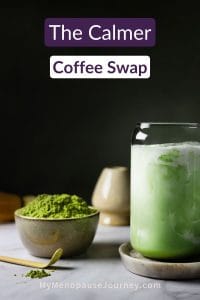
Table of Contents
Matcha vs Coffee: why it feels so different
Let’s clear one thing up first: matcha still has caffeine. A typical serving has roughly 40 to 70 mg — a good bit less than the 95 to 100 mg in a cup of coffee, but it’s there.
So why does it feel so much calmer? An amino acid called L-theanine. It’s found almost only in tea, and matcha is rich in it — the leaves are shade-grown, and you drink the whole leaf, not just steeped water. L-theanine nudges your brain into a calm, focused state and smooths out caffeine’s jittery edge.
So instead of spike → jitter → crash, you get steady → focused → settled. That’s why so many midlife women find coffee alternatives like matcha just sit better.
Matcha tea benefits for steady energy and focus
Here’s what the matcha tea benefits feel like, day to day:
- Steady alertness instead of a sharp peak
- Less of that jittery, stressy spike you can get from coffee — the L-theanine takes the edge off
- Energy that lasts, without the mid-afternoon nosedive
And that foggy feeling — where your brain is technically “on” but not really? The caffeine-plus-L-theanine pairing is exactly what helps lift it. Studies on the two together show better attention and focus than either gives alone. So matcha can leave you clear and calm rather than wired and scattered — a real gift when brain fog is part of your day.
What’s actually in matcha
This isn’t only about energy. Drinking the whole leaf means matcha is rich in:
- Antioxidants — especially a catechin called EGCG
- L-theanine, that calming amino acid
- A little chlorophyll, which gives it that vivid green
You’ll sometimes see matcha called “10 times stronger than green tea.” That’s a stretch — but it’s fair to say you get a more concentrated dose, because you’re swallowing the whole leaf instead of steeping it and pouring the leaf away.
The little extra most matcha articles skip
Have it between meals, not with your iron
Here’s one you won’t hear everywhere — and it matters in midlife. Those same antioxidants (the catechins and tannins) can grab onto non-heme iron, the kind in plants, beans and leafy greens, and block some of it from being absorbed. If your periods have been heavy in perimenopause, your iron may already be running low — so this is worth knowing.
The fix is simple: don’t drink matcha with an iron-rich meal or your iron supplement. Leave an hour or two either side, and you get all the matcha goodness without shortchanging your iron. (Meat-based, heme iron is barely affected, and a little vitamin C helps either way.)
Use cooler water, not boiling
If your matcha tastes like bitter grass, the water’s probably too hot. Boiling water scorches it. Let the kettle cool for a minute or two — about 175°F (80°C) — then whisk. You’ll get a smoother, sweeter cup, and you’ll actually look forward to it.
How to choose a good matcha
Some matcha really does taste like a lawn — usually because it’s low quality. A few quick pointers:
- Look for a bright, vivid green (dull or yellowish means older, lower-grade powder)
- Choose ceremonial grade for drinking, good culinary grade for lattes and baking
- Store it sealed, away from light and heat, and use it within a few months
Cleveland Clinic has some nice no-fuss tips for making a healthy matcha if you want to play around.
A few more matcha hacks
- Go easy on an empty stomach. Matcha can feel a bit much before you’ve eaten — some women feel queasy. Have it after a light, healthy snack.
- A splash of fat helps. Whisked with a little coconut or almond milk, the energy can feel even steadier.
- “Matcha crash” is often just dehydration. Have a glass of water alongside.
- Timing matters. Matcha’s caffeine is real, so keep it to morning or early afternoon — a late cup can cost you sleep.
Is matcha safe for everyone?
For most of us, a cup or two a day is lovely. Just remember it still contains caffeine — so if menopause has brought you palpitations, more anxiety, or restless nights, treat it like you would coffee: keep it earlier in the day, and start with a small amount to see how you feel. If you’re managing your iron, mind the timing above. And in pregnancy, count it toward your daily caffeine limit.
So, is matcha worth it?
If coffee still treats you well, wonderful — keep enjoying it. But if it’s started to feel like too much, matcha offers calm energy, steadier focus, and less stress on your system. For a lot of women in midlife, it’s less of a swap and more of an upgrade.
Those matcha tea benefits make it one of my favorite gentle superfoods for exactly this stretch of life.
And if you’re still untangling which midlife changes are even yours — what’s hormones, what’s just life — my free 5-Minute Menopause Map is a gentle place to begin.
References:
Matcha: a look at possible health benefits – Harvard Health (health.harvard.edu)
Health benefits and chemistry of matcha green tea (review) – PMC (pmc.ncbi.nlm.nih.gov)
Ways to make a healthy matcha – Cleveland Clinic (clevelandclinic.org)
Matcha and brain, heart, and gut health – Harvard T.H. Chan School of Public Health (hsph.harvard.edu)
L-theanine and caffeine effects on attention and alertness (RCT) – Biological Psychology, via PubMed (pubmed.ncbi.nlm.nih.gov)
Tea polyphenols and non-heme iron absorption – PMC (pmc.ncbi.nlm.nih.gov)

Gita is the founder of My Menopause Journey. Since 2014, she has been supporting midlife women by sharing hard-earned learnings from her own experience. To advance her knowledge, Gita puts a lot of her time and effort into understanding the broad spectrum of women’s health. She immerses in extensive research about the physical, mental and emotional aspects of menopause. Gita believes in the life-changing power of healthy, holistic living — this is where she anchors her message to all women. Learn more about her marvelous mission in About us - My Menopause Journey.


I absolutely love matcha and have tried lots of different brands over the years but one thing that I have always found with any brand and something that you didn’t mention in your article is that drinking matcha on an empty stomach in the morning can cause nausea. I love the idea that matcha is the first thing I put in my body upon waking, but the feelings of nausea are just to much to bare. Sadly disappointing but well documented fact. Recommendations are also no more than 2-3 cups of matcha per day due to its high potency (if you’re consuming high grade matcha of course!!)
Hi Lyndsey,
Thank you for your very informative comment! 💜
It’s sad to hear that you experience nausea when having a cup of matcha in the morning. Indeed, it is true that everyone is different.
Dr. Andrew Weil says that the “tannins” in matcha can temporarily raise the level of stomach acid, which may explain the occasional nausea or queasy feelings. Tannins are also known to have an astringent effect on the stomach lining — which may add to the nauseous effect.
Typically, an eight-ounce cup of matcha (made with one teaspoon of matcha powder) contains 70 milligrams of caffeine. However, it could have a little less or more depending on how concentrated one likes their cup. This means that having up to 5 cups of matcha tea is technically within the recommended daily caffeine limits of FDA for healthy adults — which is 400 mg.
But I agree with you, Lyndsey. Realistically, having 1-2 servings of matcha per day is enough to enjoy the health benefits it can offer! Since there is a wide variation in how sensitive women are to the effects of matcha’s bioactive compounds and how fast they metabolize, clinical studies are currently still being explored, regarding matcha-containing food products’ formulation, quality control and biological activities.
Again, thank you for reaching out, Lyndsey! You might be interested to check out a more recent article I have written about healthy coffee alternatives that will keep you energized in menopause. Here’s the link: Coffee and Healthy Alternatives for Women Over 40
– Gita
Thanks for sharing such unusual benefits of Matcha Tea. I am going to share your blog in my social channels.
Great job!
Thanks 🙂