It’s eleven at night, the house is finally quiet, and your head won’t be. The hot flash that woke you at 4am is still living rent-free behind your eyes. You’ve tried the chamomile tea. You’ve counted backwards from a hundred. You want one small thing that doesn’t ask much of you — and this is where aromatherapy for menopause earns its place: a few drops of the right essential oil on a tissue by your pillow, and the room shifts.
I want to be straight with you from the first paragraph. Aromatherapy is not going to fix your hormones. It’s not going to make perimenopause stop. What it can do — and the research backs this up better than it used to — is take the edge off the small daily things. The 3am wide-awake. The 3pm fog. The mood that swings without warning. The hot flash that arrives in the middle of a meeting and makes you wonder if everyone can see your face.
I’ve kept a tiny amber bottle of lavender on my desk for years. Another one in my handbag. After a decade of testing every wellness trend that promised the moon, that little bottle has earned its place. So has clary sage, on the harder weeks. Here’s what aromatherapy can realistically do for you in midlife, which oils are worth keeping in your bathroom cabinet, and the safety bits most wellness blogs forget to mention — including the one about bergamot and the sun that nobody warns you about.
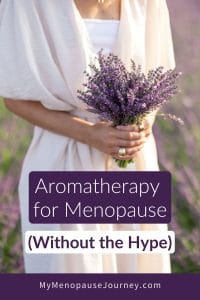
Table of Contents
Why Aromatherapy for Menopause?
Picture this: someone slices a lemon two metres away. You don’t see it happen. But within a second, your mouth is watering. That’s how fast your sense of smell talks to the rest of your body.
Smell is the most direct of all our senses. It bypasses every polite committee in your brain and goes straight to the limbic system — the small drawer in your head where mood, memory, and the “should I be calm or panicking right now” switch all live together. (It’s also why one whiff of your mum’s perfume can take you back thirty years in half a second.) Certain scents flip that switch toward calm. Lavender does it. Roman chamomile does it. Clary sage — the one women keep calling the “midlife oil” — does it too.
That’s the mechanism. The honest question is: does it actually work for menopause symptoms?
The most recent good-quality answer comes from a 2024 systematic review and meta-analysis in the Journal of Caring Sciences. The authors pulled together every randomized trial they could find on aromatherapy in menopausal women and concluded that yes, aromatherapy makes a measurable difference for some symptoms — sleep, mood, and overall menopausal symptom scores in particular. Lavender came up most often. Fennel, geranium, and clary sage came up too.
Now — a small honesty break. You’ll see “balance your hormones” plastered all over essential-oil sites. Aromatherapy doesn’t really do that. What it does is soften the symptoms the hormonal shift creates. That’s still a beautiful thing. It’s just not the same as fixing hormones. For that side of midlife, my 11 hormone secrets guide is a better starting point.
Here’s what aromatherapy can realistically help with — symptom by symptom, with what the evidence actually says.
- Mood that won’t sit still. The 2024 meta-analysis found a real, measurable improvement in mood — lavender, again, the most studied. A small 2014 study on postmenopausal women inhaling clary sage also showed reduced cortisol and improved mood. A few minutes of focused breathing with a calming oil can take the edge off when you’re about to snap at your husband over nothing. More on this in anxiety and depression in midlife.
- Hot flashes and night sweats. Peppermint, clary sage, and lavender each have small but real evidence behind them. They won’t stop a flash from coming — your hypothalamus (your body’s thermostat, currently throwing tantrums) doesn’t take orders from a roller bottle — but they can soften the panic that often comes with one. Two drops of peppermint on a tissue, held five inches from your face, is my middle-of-the-meeting trick. More on calming hot flashes here.
- Sleep that keeps abandoning you. This is where the evidence is strongest. A 2025 meta-analysis pooled three trials of aromatherapy in postmenopausal women and found a small but real improvement in sleep quality. Lavender, again. Two drops on a tissue tucked into your pillowcase costs nothing — and on the nights it works, it really works. If sleep is the symptom that’s wrecking you, this one’s worth a longer read.
- The low-grade fog. Citrus oils (lemon, sweet orange, bergamot — used carefully, see safety below) brighten the room when you walk into the kitchen at 7am feeling like a damp blanket. Not a metabolism miracle. Just a small mood-lift that costs nothing once you have the bottle.
- Libido that’s gone quiet. Less a physical effect, more a coming-back-into-yourself effect. Stress is the biggest libido killer in midlife, and the calmer warmer scents — sandalwood, jasmine, rose — can help a woman feel like herself in her own skin again. Read more on libido in midlife if this is the one keeping you up at night.
Beyond menopause specifically, there’s also reasonable evidence that aromatherapy helps with general pain perception and stress — the National Center for Complementary and Integrative Health takes it seriously enough to publish guidance, even if the science is still developing on some claims.
Essential oils themselves are nothing mystical. They’re concentrated plant extracts — pulled from flowers, leaves, roots, or bark. A whole field of lavender bottled down into one tiny amber vial, more or less.
Other Uses of Aromatherapy
Aromatherapy’s everyday uses go well beyond menopause. The reasons most women I know end up with a small collection of bottles:
- Easing a tension headache (a drop of peppermint on each temple is the classic, kept well away from the eyes)
- Helping sore muscles loosen after a long day on your feet
- Softening the kind of stress that lives in your shoulders
- Settling the mind before bed — a diffuser on the nightstand, ten minutes before lights out
- Calming an upset stomach (ginger, gently)
- Adding a small sense of ceremony to an otherwise utilitarian shower
Now — full honesty. Aromatherapy isn’t going to heal disease, and the recent meta-analyses are clear that the evidence is still mixed on several of its claims. What it does seem to do, reliably, is shift how your body feels in the moment: calmer, softer, more here. For a midlife woman who feels like her body has been hijacked, that shift isn’t small.
Aromatherapy Applications
There are three main ways to actually use essential oils, and you don’t need any fancy gadgets to start.
1. Aerial diffusion. The oils evaporate into the air — either from a small electric diffuser (mine sits on the bedside table) or from a few drops on a tissue or cotton ball tucked somewhere clever. A pillowcase. A drawer. Behind a radiator. Fills the room without overwhelming it.
2. Direct inhalation. The simplest one. Open the bottle, hold it about ten centimetres from your nose, breathe in slowly. Two or three breaths. Done. This is the fastest route to your brain’s mood drawer — which is why it works so well for a sudden hot flash, a panic spike, or the moment right before you say something you’ll regret to your husband.
3. Topical application. Diluted oils, applied to skin — in a bath, a massage, or rolled onto pulse points. This is the route that needs the most care, which is the next section.
The safety bits nobody tells you
Pure essential oils are strong. Most should never go straight onto skin — they need to be diluted in a carrier oil first. Jojoba, sweet almond, or fractionated coconut all work. The everyday rule for adult skin is 2 to 3 percent dilution. In practical numbers, that’s about 12 to 18 drops of essential oil in a 30ml (one ounce) bottle of carrier oil. Less if your skin is sensitive — and a lot of us find our skin gets more reactive in midlife, not less. Patch-test the blend on the inside of your elbow first, wait 24 hours, and only then trust it on your neck or wrist. For more on this side of things, here’s the longer essential oils how-to guide.
The bergamot-and-the-sun bit. This is the one that catches women out. Some essential oils are photosensitive — meaning if you apply them to your skin and then go out into the sun, you can come back with what looks like an unfair sunburn (and is actually called phototoxic dermatitis, a real and sometimes lasting skin reaction). The usual offenders are cold-pressed citrus oils: bergamot is the worst, followed by cold-pressed lemon, lime, and grapefruit. The safe rule: if you’ve used any of these on exposed skin, stay out of direct sun for 12 hours. Better still, keep them for evening use only. The Cleveland Clinic page on aromatherapy is a sensible plain-language read if you want more.
Don’t swallow essential oils. Ever, unless a qualified clinical aromatherapist tells you to and supervises it. The “high-quality oils are safe to ingest” line you’ll see from certain brand reps online is — to put it politely — marketing.
And if you’re on medication — particularly for blood pressure, anxiety, or anything affecting hormones — have a quick word with your doctor before you start. Essential oils are gentle, but they’re not nothing.
That’s the lot. Aromatherapy is a small daily ritual more than a treatment, and that’s its strength, not a weakness. If you want other quiet ways to soften midlife, you can also try yoga and meditation.
Commonly Used Essential Oils for Midlife
There are dozens of oils out there, but for a midlife woman these are the ones worth knowing first. I’ve put the most menopause-relevant ones at the top and trimmed the ones that don’t really earn their keep here (insect repellent and toothache oils are someone else’s article).
- Lavender — the workhorse. Calming, sleep-friendly, gentle enough that most women tolerate it well on lightly diluted skin. The oil that shows up in nearly every menopause study, for good reason. If you’re starting with just one, start here.
- Clary sage — often called the “midlife oil.” Earthy, slightly sweet scent. The 2014 Lee et al. study on postmenopausal women inhaling clary sage found reduced cortisol and improved mood. Popular for the kind of cramping and emotional dips that can come during perimenopause.
- Roman chamomile — softer and more apple-like than its German cousin. Pairs beautifully with lavender for sleep. Two drops of each on a tissue by your pillow is a good place to start.
- Peppermint — sharp, cooling, useful for a sudden hot flash (a drop on a tissue, breathed in from arm’s length) and for tension headaches. Dilute well if you’re going on skin — it tingles, and not in a way you want everywhere.
- Geranium — floral, slightly rose-like, often combined with clary sage in midlife blends. Lifting without being heavy.
- Bergamot — citrusy, lightly floral, brilliant for mood — but the photosensitive one (see the sun warning earlier). Keep this one for evenings, or use it only in a diffuser if your days are sunny.
- Sandalwood — warm, woody, deeply calming. The classic “I want to feel like myself again” oil. Often used in libido-friendly blends with rose or jasmine.
- Lemon oil — bright, clean, mood-lifting. Steam-distilled lemon (not cold-pressed) avoids the photosensitive issue, if you want citrus during the day.
- Jasmine — heady, floral, traditionally used in romance and confidence blends. A little goes a very long way.
- Thyme — a smaller player in midlife but a useful one for fatigue and stress.
For a deeper dive into individual oils, blends, and which ones play well together (and which really don’t), my eight most-loved essential oils guide goes into all of that.
Three things that matter more than the brand on the bottle
- Quality. Look for “100% pure essential oil,” the Latin name of the plant on the label (e.g. Lavandula angustifolia, not just “lavender”), and a country of origin. If a bottle costs €3 in the discount aisle, it’s probably synthetic — and synthetic doesn’t do what real essential oil does, no matter what it smells like.
- Less is more. Three drops works as well as ten. The smaller dose is gentler on skin, easier on a midlife liver, and stretches the bottle.
- Listen to your skin. If something stings, itches, or feels wrong, stop. Sensitization is real and tends to creep up over time, not all at once. The oil you used happily last summer can suddenly turn on you. Rotate, rest, don’t use the same blend every single day for months.
Have you found a particular oil or blend that’s helped you through the worst of the wakeful nights, the moods, or the heat? I’d love to hear which one. Drop a note in the comments below — half the wisdom in this space gets passed woman-to-woman, kitchen-to-kitchen, not from research papers.
References:
Aromatherapy for the Management of Menopause Symptoms: An Updated Systematic Review and Meta-analysis – PubMed Central (pmc.ncbi.nlm.nih.gov)
The Effects of Aromatherapy on Sleep Quality in Menopausal Women: A Systematic Review and Meta-Analysis – Women / MDPI (mdpi.com)
Aromatherapy: overview, uses, and safety – Cleveland Clinic (my.clevelandclinic.org)
Phototoxicity: essential oils, sun and safety – Tisserand Institute (tisserandinstitute.org)
Lavender and aromatherapy: what the science says – NCCIH (nccih.nih.gov)

Written by Gita — Certified Fasting Therapist, Nutrition Coach and Keto Coach, and founder of My Menopause Journey since 2014. Every article is built on published research and trusted health sources, updated regularly, and shaped by her own journey through menopause. Read more about Gita and her credentials.