Wait — what’s fermenting got to do with midlife? More than you’d think.
Somewhere around 40, your body starts pulling little stunts. One day you breeze through brunch. The next, a single slice of toast leaves you bloated and wondering who swapped your metabolism for a slower, older model.
This is where fermented food quietly earns its place. Those funky, tangy little jars won’t stop a hot flash or hand you back your 25-year-old digestion — but they can help you feel a bit more like yourself, minus some of the mystery bloat.
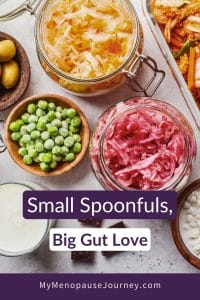
Table of Contents
What is fermented food, anyway?
Fermented food is what happens when good bacteria throw a party and stick around. Through fermentation, tiny microorganisms — friendly bacteria and yeasts — break down the sugars and starches in food. What’s left is tangy, sometimes fizzy, and rich in probiotics (the live, helpful bacteria).
Some you probably already know:
- Yogurt — look for “live and active cultures”
- Kefir — yogurt’s drinkable, tangier cousin
- Sauerkraut and kimchi — fermented cabbage with a kick
- Miso — salty, savory umami
- Tempeh — fermented soybeans, and a good hit of protein
- Kombucha — fizzy, lightly sweet fermented tea
- Pickles — but only the ones fermented in brine, not vinegar
Harvard’s nutrition team notes that fermented foods can add real depth to your diet — and a welcome boost for your gut.
Why your 40-plus gut needs a little extra love
Here’s the scoop: once estrogen and progesterone start fluctuating, your gut feels it too. That’s part of why bloating, sluggish digestion, and general tummy grumpiness show up more in midlife.
Fermented food brings in probiotics that help your gut microbiome stay diverse and balanced. A happier gut tends to mean:
- Smoother digestion
- Better absorption of the nutrients in your food
- A steadier immune system
- And — yes, really — a lift for your mood
One Stanford study found that eating more fermented food increased gut microbiome diversity and lowered markers of inflammation. That’s a solid, real benefit — no hype needed.
Can fermented food really help my hormones?
Midlife hormones can feel like the friend who never texts back — unpredictable. So can fermented food calm the chaos? Honestly: a little, indirectly, and the science is still early.
Here’s the honest version. Your gut bacteria help process and recycle estrogen (researchers call this corner of the microbiome the “estrobolome”). A balanced gut may support that work, plus steadier blood sugar and lower inflammation. There’s even some early research hinting probiotics might ease certain menopausal symptoms — but those studies are small and shaky, so I won’t promise you fewer hot flashes.
What I’ll say is this: fermented food isn’t a hormone fix. It’s gentle, foundational support — and in midlife, that’s worth a lot.
The gut-mood connection
Feeling a bit flat, or anxious for no clear reason? Your gut and brain are in constant conversation along what’s called the gut-brain axis. Your gut even makes most of your body’s serotonin.
Now, that gut serotonin mostly stays busy in your gut, not your brain — so this isn’t as simple as “eat kimchi, feel happy.” But the link between a healthy microbiome and steadier mood and clearer focus is real and genuinely exciting. So next time you’re in a funk, it might not be all you — your microbiome may have a say.
The histamine catch (the part most articles skip)
Here’s something you won’t read everywhere — and it matters more in midlife. Fermented food is naturally high in histamine. For most women that’s no problem at all. But if you’re histamine-sensitive, fermented food is often the single biggest trigger — think flushing, headaches, hives, a racing heart, itchy skin, or an unsettled tummy after that kombucha or forkful of sauerkraut.
And this is where menopause sneaks in: as estrogen shifts, histamine sensitivity can rise (estrogen and histamine egg each other on, and DAO — the enzyme that clears histamine — can dip). So if fermented foods have started to disagree with you lately, you’re not imagining it.
The fix isn’t to give up on your gut. Go gentler: ease off the most histamine-heavy, long-aged ferments (aged cheese, kombucha, sauerkraut), lean on plenty of fiber-rich vegetables, and — if you want the probiotic upside without the histamine — a good probiotic supplement with the right strains can be a kinder route. If your reactions are strong, it’s worth getting properly checked.
How to add fermented food without overhauling your life
You don’t need a fermentation lab on your counter (though if that’s your thing — go for it). Start small:
- A spoonful of sauerkraut on a salad or sandwich
- Yogurt or kefir in place of sour cream
- A little kombucha instead of an afternoon soda
- A teaspoon of miso stirred into hot water for a two-minute soup
- A forkful of kimchi on your eggs or grain bowl
Go slowly — your gut may need time to adjust, and too much too fast can mean gas or bloating. A few more things worth knowing:
- Read the label. Some store-bought versions are pasteurized or loaded with sugar and vinegar, with no live cultures left. Checking labels helps you spot the real thing.
- Mind the salt. Many ferments are very salty — something to watch if you’re keeping an eye on blood pressure.
- Homemade often wins. A jar of your own sauerkraut or kombucha usually carries a far wider range of bacteria than a supermarket tub of yogurt with just a strain or two.
Fermented food vs. probiotic pills — which wins?
Sometimes you want the benefits without braving the tangy stuff. So which is better?
Fermented food gives you a whole-food package: live bacteria plus the fiber, enzymes and prebiotics that feed them — and it’s the more affordable, sustainable route. Supplements are convenient, easy to dose by strain, and handy when your gut’s been through the wringer (after a stomach bug or antibiotics) — or, as we said, if histamine is an issue.
Best bet for most women? A bit of both. Small amounts of fermented food day to day, and a quality probiotic when you need extra support.
FAQ
Why should I suddenly care about fermented food?
Because your body at 40-plus isn’t playing by the old rules. As hormones shift, digestion gets more sensitive — and fermented food helps keep your gut running more smoothly.
Can it really help my hormones?
Indirectly. Fermented food doesn’t fix hormones, but a healthier gut helps your body process estrogen, calm inflammation, and steady blood sugar — which can take the edge off the mood whiplash.
Do I have to choose between fermented food and probiotic pills?
No — most women do well with both. If you’re histamine-sensitive, though, lean toward the right probiotic strains and go easy on the ferments.
Is the mood link real, or just wellness fluff?
It’s real, though not magic. Your gut and brain genuinely talk to each other, and a balanced microbiome supports steadier mood — it’s one piece of the puzzle, not a cure.
I’m too tired to DIY anything. Easiest way in?
A spoonful of sauerkraut on your eggs. A splash of kefir in a smoothie. A kombucha instead of soda. Start slow, see what feels good, and remember: consistency beats perfection.
Give your gut a little love
Look after your gut, and your mood, energy and hormones may quietly follow. Fermented food is one of my favorite gentle superfoods for this stage of life — small, affordable, and genuinely good for you.
And if you’re still working out which midlife changes are even yours — what’s hormones, what’s just life — my free 5-Minute Menopause Map is a gentle place to start.
References:
Health benefits and risks of fermented foods (PIMENTO review) – Frontiers in Nutrition (frontiersin.org)
Fermented foods can add depth to your diet – Harvard Health (health.harvard.edu)
Health benefits of fermented foods: microbiota and beyond (review) – PubMed (pubmed.ncbi.nlm.nih.gov)
Fermented foods, microbiota, and mental health (review) – PMC (pmc.ncbi.nlm.nih.gov)
Fermented-food diet increases microbiome diversity, lowers inflammation – Stanford Medicine (med.stanford.edu)
Histamine intolerance: causes, symptoms and management (review) – PMC (pmc.ncbi.nlm.nih.gov)

Written by Gita — Certified Fasting Therapist, Nutrition Coach and Keto Coach, and founder of My Menopause Journey since 2014. Every article is built on published research and trusted health sources, updated regularly, and shaped by her own journey through menopause. Read more about Gita and her credentials.