
Let’s talk hydration — really talk about it. Not the tired “drink eight glasses of water” line. The kind where you’re drinking water all day and still feel foggy, flat, and meh, even after a full night’s sleep.
Sometimes that’s your body asking for more than water. It wants minerals too. And that’s where coconut quietly steps in.
But here’s the thing the “coconut superfood” hype usually skips: coconut shows up in your kitchen in about five forms — water, oil, milk, fresh meat, flour — and they are not the same food. One’s a lovely hydrator. One’s almost pure saturated fat. So let’s sort the genuinely useful from the oversold, woman to woman.
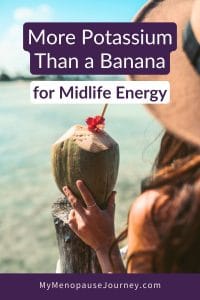
Table of Contents
Coconut water — the genuinely useful one
This is coconut at its best for midlife. Coconut water is mostly water, naturally low in calories (about 45 to 60 a cup), with just gentle natural sugars — and it’s rich in potassium, plus some magnesium and a little calcium. One cup gives you more potassium than a banana.
Those minerals help your body manage fluid balance, muscle and nerve function, and that wrung-out feeling after a hot day. So before you reach for another coffee at 3 p.m., a glass of coconut water is often the smarter pick.
One honest catch, because the marketing oversells this: coconut water is low in sodium — and sodium is the main thing you lose when you really sweat. And in midlife you may be sweating more than ever — every hot flash and night sweat drains a little fluid and salt. So coconut water is a lovely everyday sip, but it’s not the magic rehydration cure it’s sold as: on a heavy-sweat day, pair it with a pinch of salt or a snack.
And go easy if you have kidney trouble or take potassium-affecting medication — all that potassium adds up if you’re drinking it by the bottle. A cup or two a day is plenty.
The “tired but wired” afternoon
You know the other kind of tired — not sleepy, but waking up drained, feeling wired and exhausted at once, then crashing hard mid-afternoon. Stress, broken sleep and lots of sweating can genuinely leave you a little low on fluids and minerals, and topping those back up does help you feel steadier.
Just don’t expect coconut water to fix your stress hormones — it won’t, and nothing in a glass will. Think of it as gentle replenishment, not a cure. Sometimes your body doesn’t need another coffee. It needs water, minerals, and a breather.
Coconut oil and the fat question
Here’s where I have to be straight with you, because the internet usually isn’t.
First, the number everyone argues about: coconut oil is over 80% saturated fat — more than butter. One tablespoon holds close to a whole day’s recommended limit. Like other saturated fats, it nudges up LDL (“bad”) cholesterol, which is why Harvard’s nutrition experts and the American Heart Association say to use it sparingly and lean on unsaturated oils like olive and avocado day to day.
Here’s the honest part, though: this one is genuinely debated. The functional-medicine world — including voices I trust — sees coconut oil more kindly: a stable fat that handles heat well, eaten for generations as part of whole-food diets, with the saturated-fat-and-heart story far from settled. My take on the sensible middle? Coconut oil is a perfectly good cooking fat in moderation, especially for higher-heat cooking. Just not something to drown your food in, or treat as medicine.
“But the MCTs!” — I hear you. Yes, coconut oil contains some medium-chain triglycerides, the fats tied to “brain fuel” and a metabolism boost. The honest truth: those studies almost always used pure, concentrated MCT oil — a different product. Regular coconut oil is only about 15% true MCTs, and its main fat (lauric acid) behaves more like an ordinary long-chain fat. So the “brain fuel” and “fat-burning” claims for coconut oil itself are mostly wishful thinking.
None of this makes coconut oil the enemy. Use it the way you’d use butter — a little, for flavor, when its taste is the point. Just don’t pour it into your coffee expecting magic.
Where coconut oil really shines: skin, hair — and a little lower
Here’s the coconut oil win the supplement crowd forgets — and it’s made for midlife. On your skin, not in your coffee, coconut oil genuinely delivers. It’s been shown to soften dry skin, calm eczema-prone patches, and strengthen hair. And dry, thirsty skin and brittle hair are exactly what tends to creep up as estrogen drops. A little warmed between your palms makes a lovely overnight hair mask or an elbow-and-heel balm.
And — let’s be women about this — coconut oil is also a simple, gentle helper for the dryness no one warns you about: vaginal dryness. As estrogen dips, that tissue gets drier and more delicate, and a little coconut oil can soothe and ease friction. (Mine lives on the bedside table — no shame here.) Two honest cautions, though: it isn’t safe with latex condoms (the oil breaks them down — use a water- or silicone-based lube for that), and if you’re prone to yeast infections, go easy, since oil can nudge your natural pH. For everyday external dryness, it’s lovely.
Coconut meat, milk and flour — the rest of the family
A quick rundown of the others:
- Fresh or dried coconut (the meat) — has fiber and a little protein alongside the fat. A sprinkle of unsweetened shredded coconut on yogurt or oatmeal is satisfying. Just remember it’s calorie-dense — a sprinkle, not a bowlful.
- Coconut flour — high in fiber and naturally grain-free, a handy baking swap if you’re cutting back on wheat. It drinks up liquid, so recipes built for it work best.
- Coconut milk — rich, creamy, and a brilliant dairy-free swap for cream. I use it exactly that way — stirred into cauliflower mash, or in place of cream in sauces. Good or bad? Honestly, neither: full-fat coconut milk is about as rich as cream (similar saturated fat), so it’s not a “lighter” choice, just a lovely plant-based one. Watching saturated fat? Reach for the light version. Otherwise, enjoy it.
Coconut superfood: real or hype?
So is coconut a superfood, or just a trend? Honestly — a bit of both, depending which coconut you mean.
Coconut water earns its place as a gentle, mineral-rich hydrator. Coconut oil is a fine occasional flavor fat and a genuinely good skin-and-hair treat — but not a metabolism miracle. The meat, milk and flour are useful whole-food extras in sensible amounts.
Used that way — knowing what each form actually does — coconut absolutely deserves a spot in your kitchen. That’s the honest coconut superfood story: useful, simple, no halo required.
How I’d use coconut in midlife
- Coconut water — your everyday hydrator; pick 100% pure with no added sugar; pair with a salty snack after heavy sweat.
- Coconut oil — small amounts for cooking when the flavor counts; the rest for your skin, hair, and easing the dryness no one warns you about.
- Coconut milk, meat and flour — flavor and texture in real meals; keep portions sensible.
- Pair it with protein — coconut alone won’t keep you full, so add a handful of nuts or some yogurt.
The simple truth
Coconut isn’t magic — but it is simple, and in midlife, simple done well goes a long way. It’s one of my favorite gentle superfoods when you use each part for what it’s truly good at.
And if you’re still working out which midlife changes are even yours — what’s hormones, what’s just life — my free 5-Minute Menopause Map is a gentle place to start.
References:
Coconut oil consumption and cardiovascular risk factors (AHA advisory) – Circulation (ahajournals.org)
Is there a place for coconut oil in a healthy diet? – Harvard Health (health.harvard.edu)
Coconut oil – Harvard T.H. Chan, The Nutrition Source (nutritionsource.hsph.harvard.edu)
Coconut water: is it good for you? – Cleveland Clinic (clevelandclinic.org)
Coconut water and electrolytes – American Society for Nutrition (nutrition.org)
Coconuts and health: chain lengths of saturated fats (review) – PMC (pmc.ncbi.nlm.nih.gov)
Topical coconut oil for skin and hair (study) – PubMed (pubmed.ncbi.nlm.nih.gov)

Written by Gita — Certified Fasting Therapist, Nutrition Coach and Keto Coach, and founder of My Menopause Journey since 2014. Every article is built on published research and trusted health sources, updated regularly, and shaped by her own journey through menopause. Read more about Gita and her credentials.