Crying over nothing. Snapping at the people you love. A mind that races at 3 a.m. The emotional symptoms of menopause are some of the most common — and most brushed-off — signs that your hormones are on the move. It’s not weakness, and it’s not “just stress.” It’s your hormones, your brain chemistry and your whole body asking for support. So let me show you what’s going on inside, and where to find relief that’s kind, natural and actually doable.
I got a very open and transparent email from a woman last week… and her words have stayed with me. Not just because of what she’s carrying, but because I know so many of us have felt something similar. Crying in the bathroom. Snapping at someone we love. Lying awake at 3 a.m., wondering what happened to the “real me.”
She told me her story. She’s going through perimenopause — already a challenging transition — while also caring for her mother, who has moved in with her. The atmosphere at home has felt heavy. Her mom is struggling in her own way, and at times, the mood can become quite low for the both of them.
She finds herself feeling everything so deeply. To stay grounded, she’s been listening to mental health podcasts — hoping to shift her thinking, stay positive, and find the strength to keep going.
And I felt this ache in my chest. Because I’ve been there, too. You know, trying to push away the anger, the fog, the tears, the fatigue, the anxious swirl in my core. Telling myself I just need to try harder. Smile more.
Yes — when you’re in perimenopause, your brain doesn’t feel like your own. And it’s tricky, because most of what we hear about menopause is hot flashes and night sweats.
We never really got to understand that many women feel the emotional symptoms of menopause long before their periods stop. And so, this knowledge gap can leave us thinking, “Why am I so emotional during menopause? What’s happening to me? Am I losing it?”
But here’s the truth: You’re not losing it. And you’re definitely not imagining things. You’re going through one of the biggest hormonal transitions of your life. And yes — it’s your brain getting caught in the middle of all of it.
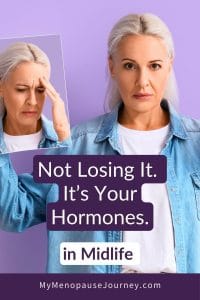
Table of Contents
Why Am I So Emotional During Menopause? Blame Your Brain Chemistry
Let’s start with this: your hormones don’t just control your period or fertility. They affect your entire system — including the chemistry of your brain.
That’s why, at first, perimenopause often doesn’t look like hot flashes. It’s more about mood swings you can’t seem to explain, including:
- Sudden anxiety
- Irritability and a shorter fuse than you’ve ever had
- Crying over nothing (hello, dog-food commercial)
- Panic that comes out of nowhere
- Racing heartbeat for no apparent reason
- Feeling low or numb
- Snapping at the people you love — and feeling far from your partner
- Foggy mind
- Fatigue
- Waking up at the oddest hours every night with spiraling thoughts
- Emotional eating and cravings
Your Body Is ONE System: The Emotional Symptoms of Menopause Aren’t Just Hormones
Your hormones don’t work alone. They’re part of one big, connected system — and when one part wobbles, your mood feels it. Before we get to the three big hormones, here are the other players:
- Your thyroid. A slow thyroid can look a lot like menopause: low mood, tiredness, a short fuse. Worth a blood test.
- Your blood sugar. When it crashes, your body pushes out stress hormones to bring it back up. Hello, shaky, teary, “hangry” 11 a.m.
- Your stress system. Months of caring for everyone keep cortisol switched on — and a stressed body has less room for calm.
- Your sleep. Night sweats and 3 a.m. wake-ups chip away at your patience. Poor sleep makes every feeling louder.
Here’s what’s really going on underneath it all… Let’s call it your menopause brain chemistry.
(Hint: a lot of those emotional symptoms have got something to do with your hormones and neurotransmitters)!
Progesterone and Anxiety — Featuring GABA
Progesterone calms your nervous system. It helps you sleep, slow down, and feel safe.
So, when it drops in perimenopause (yes, it’s the first key hormone to decline), your inner alarm system gets louder. That’s because progesterone helps your brain use GABA — your natural “calm down” messenger. Less progesterone, less calm. You might feel wired, overwhelmed, or like you can’t unwind, no matter how tired you are. She’s the same hormone behind those PMS blues you had during your teenage years!
How Estrogen Affects Mood + Its Role in Serotonin Production
Estrogen helps your brain make serotonin — that “feel good” brain chemical. When estrogen starts to swing — and in perimenopause it doesn’t glide down, it spikes and dips like a rollercoaster — serotonin swings with it. That’s why you’re likely to feel down, anxious, or “off,” even if nothing in your life has changed.
In fact, perimenopause is the most sensitive time of all for low mood — more on that in my article on anxiety and depression in menopause.
Testosterone: What Shifts Your Drive (In and Out of Bed!)
Testosterone has been slowly sliding down since our 30s — no sudden crash, just less and less. This hormone is responsible for motivation, energy, and libido. So, if you’re feeling flat, foggy, or just not like yourself… that’s not you being lazy. That’s your brain chemistry shifting.
So, no — you’re not “too sensitive.”
The emotional symptoms of menopause — all the highs and lows — are not flaws. They’re signals.
If you’re reacting more strongly to the people around you, the stress, the noise, the demands — it’s not because you’re losing your edge. It’s because your nervous system is in flux, your emotional bandwidth is stretched, and your body is asking for help.
You don’t need a new mindset overnight.
You need relief.
Why “Fixing Your Thoughts” Won’t Fix Your Hormones
These days, there’s a lot of talk about starting with mindset — shifting your thinking, reframing your story, and leaning into more positive thoughts. And while that can be helpful, especially in the right moment, it’s not always the whole picture.
But here’s the thing: if your gut is inflamed, your hormones are crashing, your nutrient stores are depleted, and your nervous system is stretched thin — your brain may not have the foundation it needs to access those feel-good thoughts.
Put simply: your thoughts don’t create hormones. But your hormones and your gut absolutely shape your thoughts.
In fact, about 90% of your serotonin is made in the gut. And your gut and brain talk to each other all day long. So, if your gut’s unhappy, chances are your brain isn’t feeling great either. Add stress, poor sleep, and hormonal turbulence to the mix? No wonder you feel like you’re unraveling.
Now, don’t get me wrong — mindset tools do help. Talking therapy like CBT is now recommended for low mood in menopause. They just work so much better on a body that’s fed, rested and supported.
That’s not a personal failure.
That’s your biology asking for support.
Natural Mood Support During Menopause: How to Boost Your Midlife Headspace (Without Blaming Yourself)
If you find yourself nodding along with the things and scenes we’ve mentioned above, here’s what I want you to know: There’s hope.
And it starts by getting out of your head — and back into your body. Here’s where you begin:
Support Your Gut: Lay the Foundation
Think of your gut as the foundation of your home. If the base is cracked, everything built on top wobbles. The same goes for your health! Eat in a way that’s kind to your digestion — gentle, grounding foods like bone broth, fermented foods, good proteins, and fiber-rich plants.
And if you’re feeling bloated, gassy, or backed up, that’s not just annoying — it’s your body’s version of a warning light on the dashboard. Listen to it.
Reduce the Noise: Turn Down the Static
Stress isn’t just “in your head” — it’s like static that drowns out your body’s natural rhythms. Imagine trying to tune in to your favorite song, but the station is fuzzy. That’s what chronic stress does to your gut and hormones. You don’t need a luxurious silent retreat — just small moments to feel safe again.
Try breathwork. Take a walk without your phone. Spend time with nature. Sit outside and meditate for five quiet minutes. Every little form of calm turns the dial down.
Give Your Body the Raw Materials: Stock the Toolbox
You wouldn’t expect a builder to work without tools. Your body’s the same. It can’t create those soothing, feel-good brain chemicals out of thin air! And especially not with substandard materials.
It needs high-quality fuel, like healthy fats, amino acids, magnesium, B-vitamins, and other essential nutrients.
Think real food first, then supplement when needed. That’s not being “extra” — that’s you giving your body the parts it needs to rebuild and recenter! One quick heads-up: St John’s Wort and 5-HTP or tryptophan don’t mix with antidepressants — check with your doctor first.
Hormone Therapy? It Can Help — Alongside the Basics
Menopausal hormone therapy (HRT) can absolutely be a helpful tool — sometimes it’s just what you need to take the edge off when things feel especially rough. It can ease mood swings and low mood linked to perimenopause — especially when night sweats are wrecking your sleep. It isn’t a treatment for depression on its own, though. But even then, it works best when the foundations are in place.
If your gut is out of balance, your stress is running high, and your cells are running on empty, even the best hormone therapy might not land the way it’s meant to. It’s like trying to flip on a light switch when the wiring is still a bit frayed — the spark might flicker, but it won’t glow strong.
So yes, consider HRT if it’s right for you and your doctor agrees. But at the same time, support your base: nourish your gut, calm your nervous system, and feed your body what it’s really missing. That’s how you give any therapy — natural or medical — the best chance to truly help.
When It’s More Than Hormones
Not every low mood is one of the emotional symptoms of menopause. If your mood has been low most days for two weeks or more, please see your doctor. If dark thoughts creep in, reach out right away to someone you trust or a local support line. And chest pain, shortness of breath or fainting always means emergency care — even if you think it’s “just” panic.
Where to Go Next
The emotional symptoms of menopause come in many shapes. Pick the one that feels most like you right now:
- Mood swings and rage? Start with mood swings in menopause.
- Anxious, low or flat? Read anxiety and depression in menopause.
- Heart pounding out of nowhere? Here’s my guide to panic attacks in menopause.
- Tension at home? See relationship changes during perimenopause.
Let This Be Your First Step
If any part of this feels like your life right now — the heaviness at home, the rollercoaster of emotions, the exhaustion you can’t quite name — I want you to hear this:
Trust me, you’re in very good company.
And there’s nothing wrong with you.
You’re living through one of the most powerful (and often overlooked) transitions of a woman’s life. And still — you keep showing up. You’re searching for answers, for calm, for clarity.
So let this be your first small step forward.
The 5-Minute Menopause Map is a simple, gentle guide to help you see where you are — and where you might go next. No deep dives. No pressure. Just a clear, caring starting place.
Because sometimes, the hardest part is just knowing where to begin.
So, start here.
Start with you.
Start with compassion, not criticism.
And please remember:
You’re not unraveling.
You’re responding — to change, to hormones, to everything life is asking of you.
There is a way through.
And I’ll be right here as you find it.
FAQ: Emotional Symptoms of Menopause
Why am I so emotional during menopause?
The emotional symptoms of menopause are often caused by shifting hormones like estrogen, progesterone, and testosterone. These hormones directly affect brain chemicals like serotonin and GABA, which influence mood, anxiety, and mental clarity.
Is crying a lot a symptom of perimenopause?
Yes. Many women experience increased sensitivity, mood swings, and emotional outbursts during perimenopause due to hormonal fluctuations — especially a drop in progesterone, which normally helps calm the nervous system.
Can menopause cause anxiety and panic attacks?
Yes. Lower estrogen can reduce serotonin production, making anxiety more common. Hormonal shifts can also impact the nervous system, leading to symptoms like a racing heart or feelings of panic, even without external stressors. A panic attack usually peaks within about 10 minutes and passes in 5–20. If it comes with chest pain, shortness of breath or fainting, get emergency care.
How can I naturally support my mood during menopause?
Focus on gut health, nutrient-rich foods, rest, and stress reduction. Supplements like magnesium, omega-3s, and B-vitamins may also help. Mindset matters too — but your body needs a foundation of nourishment and safety first.
When should I consider hormone therapy for emotional symptoms?
HRT can be a helpful option for some women, especially when emotions feel overwhelming. But I always come back to this: building a strong, well-nourished body with food, movement, and stress support is the real foundation — with or without hormones.
How long do emotional symptoms of menopause last?
For most women they’re strongest in perimenopause, when hormones swing the most. Your brain adapts to lower estrogen over time, and many women feel steadier once the transition settles. Supporting your body now helps it get there sooner.
References:
Menopause – Symptoms – NHS (www.nhs.uk)
Menopause: identification and management (NG23) – NICE (www.nice.org.uk)
Menopause impacts human brain structure, connectivity, energy metabolism, and amyloid-beta deposition – Scientific Reports (pubmed.ncbi.nlm.nih.gov)
Serotonin: what is it, function & levels – Cleveland Clinic (my.clevelandclinic.org)
Gut-brain axis: how the microbiome influences anxiety and depression – PubMed (pubmed.ncbi.nlm.nih.gov)

Written by Gita — Certified Fasting Therapist, Nutrition Coach and Keto Coach, and founder of My Menopause Journey since 2014. Every article is built on published research and trusted health sources, updated regularly, and shaped by her own journey through menopause. Read more about Gita and her credentials.