You’ve seen the photos. The bowl dusted with something green and expensive. The promise that one scoop will fix the bloat, the brain fog, the body that suddenly doesn’t answer to you anymore.
I’ve bought the powders. Half of them are still in my cupboard, judging me.
Here’s what I’ve learned testing this stuff on my own midlife body: superfoods for menopause are real and useful — just not the way the marketing wants you to believe. They’re not a rescue. They’re a quiet upgrade to an already-decent plate. Let me show you which ones earn their place, and which ones are mostly clever packaging.
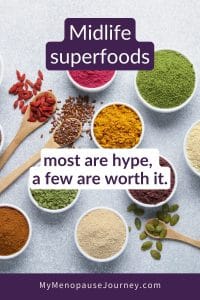
Table of Contents
First, the honest bit — what a “superfood” even is
Brace yourself: technically, there’s no such thing.
“Superfood” isn’t a scientific category. It has no legal definition. It’s a marketing word — so loose that the EU banned putting it on packaging back in 2007 unless you could actually prove the health claim behind it. The dietitians at Mayo Clinic will tell you the same thing.
So no single berry is going to undo a hard decade of hormones. Anyone promising that is selling something.
But here’s the part worth keeping: the foods that earn the “super” label do share something real — they’re nutrient-dense. A lot of vitamins, minerals, fiber and antioxidants per bite. The fix isn’t chasing the most exotic powder on the shelf. It’s eating a wide variety of these foods on top of a balanced plate. Variety is the actual superpower.
Why this matters more in midlife
When estrogen starts its long goodbye, a few things shift at once. Bone turns over faster, so calcium, vitamin D and protein suddenly matter more. Blood sugar gets twitchier. The gut gets moodier. And low-grade inflammation creeps up.
None of that is fixed by a smoothie. But a plate built around fiber, healthy fats, protein and colorful plants gives your body better raw materials to work with through the messy years. That’s the whole game — and it’s why I treat superfoods for menopause as support, never treatment.
The superfoods for menopause I actually reach for
The superfoods for menopause I actually reach for
When people ask me which superfoods for menopause actually earn a spot in my kitchen, these seven are it.
Turmeric
The yellow one. Its claim to fame is curcumin — a compound with real anti-inflammatory research behind it, which is why I reach for it on stiff, achy mornings. You’ll see turmeric called a “phytoestrogen” all over the internet. It isn’t really one — so I use it for inflammation, not for hormones. Read more: turmeric health benefits.
Ginger
My go-to for a queasy stomach, and it carries the same anti-inflammatory perks as its cousin turmeric. Gentle, cheap, in every shop. Read more: ginger health benefits.
Matcha
Whole green tea, stone-ground to powder. The reason I pick it over coffee: it pairs caffeine with L-theanine, so you get calm-alert instead of jittery-then-crashing. Read more: matcha tea benefits.
Avocado
Healthy fat, fiber and folate in one creamy package — and it keeps me full, which my midlife appetite genuinely appreciates. Read more: avocado nutrition and benefits.
Fermented foods
Sauerkraut, kimchi, kefir, miso. Living foods for a happier gut — which, during menopause, is doing more behind the scenes than you’d think. Read more: fermented food benefits.
Bone broth
Collagen, protein and minerals in a mug. Comforting, and kind to a gut that’s turned sensitive. Read more: bone broth benefits.
Coconut
From the oil to the milk to the flesh — a versatile healthy fat I cook with, and one I come back to for skin and for the fasting window. Read more: coconut, the all-around superfood.
Berries and botanicals worth a look
Most of these started life as their own little posts — I’ve gathered them here so you’ve got the lot in one place. Think of them as the supporting cast of menopause superfoods: nice to have, not essential.
- Blueberries — the most-studied berry on the list, and it earns the spot. The deep-blue pigment (anthocyanins) shows up in real research on sharper memory and heart health, both worth protecting in midlife. Fresh or frozen makes no difference — frozen are picked ripe and usually cheaper. A handful most days is plenty.
- Cranberry — worth knowing because UTIs get more common after menopause, when falling estrogen thins the urinary tract. Cranberry’s proanthocyanidins make it harder for bacteria to cling to the bladder wall, and the research suggests it can cut the odds of repeat infections in women who get them often. One honest line, though: it helps prevent, it doesn’t treat. If an infection’s already brewing, that’s a call to your doctor, not your juice glass — and skip the sugary cocktails; unsweetened juice or a standardized capsule is the version that counts.
- Goji berries — chewy, faintly sweet, and genuinely rich in vitamin C plus the eye-friendly antioxidants lutein and zeaxanthin. Lovely on porridge or in trail mix. Don’t expect the “longevity berry” miracle on the packet — and if you take a blood thinner like warfarin, check with your doctor first, as goji can interfere with it.
- Açaí — an antioxidant-dense Amazonian berry, genuinely good in its plain, frozen, unsweetened form. The catch is what’s usually done to it: most bowls and sachets are loaded with added sugar, which quietly undoes the point. Buy the unsweetened purée or powder and sweeten it yourself with fruit — and ignore the “detox” and “fat-burning” claims, which are marketing, not biology.
- Baobab — a tangy African fruit powder, high in vitamin C and, more usefully, the prebiotic fiber that feeds the good bacteria in your gut. A spoon in yogurt or water is an easy fiber top-up, and most of us could use more fiber in midlife.
- Camu camu — one of the richest natural sources of vitamin C there is, so a small half-teaspoon does the job. Tart on its own, much nicer blended into a smoothie. A little goes a long way here — more isn’t better.
- Bee pollen — little granules with a bit of protein and trace nutrients, pretty on a yogurt bowl. The caveat matters: if you have pollen or bee allergies, skip it, because reactions can be serious. You’ll get the same nutrients more safely from eggs, leafy greens or a B-vitamin-rich food.
- Sea vegetables (nori, wakame, kelp) — mineral-rich, and one of the few plant sources of iodine, which your thyroid needs. But midlife is exactly when thyroids turn temperamental, and too much iodine throws one off as easily as too little. Enjoy them as the occasional side or sushi wrap rather than daily kelp tablets, which can pack wildly high iodine doses — and if you’ve got a thyroid condition, run it past your doctor.
- Dark chocolate — yes, it counts, and no, I’m not bargaining. Cocoa flavanols are linked to better blood flow and a real little lift in mood. The trick that keeps it a superfood rather than a dessert: choose 70% or darker, and stop at a square or two. The milk bar at the checkout doesn’t qualify, I’m afraid.
A word on green powders — spirulina, chlorella, moringa
Green powders are the flashiest of the menopause superfoods — and the ones that most need a quality check. These are legitimately nutrient-dense — protein, iron, B-vitamins, antioxidants — and I’ll stir a spoon into a smoothie when I want a quick top-up. Two honest caveats up front: the taste is an acquired pond, and quality really matters, because algae especially can take up heavy metals or natural toxins from the water they’re grown in.
- Spirulina — a blue-green algae that’s genuinely protein-rich, with iron and B-vitamins. Sourcing is everything here: poorly grown spirulina can carry heavy metals or microcystin toxins, so buy a brand that third-party tests its batches.
- Chlorella — a similar nutrient story, with a fibrous cell wall thought to bind onto some metals in the gut. Same sourcing caution applies — and start with a small dose, as it can be rough on the stomach at first.
- Moringa — dried leaves of the moringa tree, closer to a concentrated leafy green than an algae. A milder, pleasant way to add iron, calcium and antioxidants to a smoothie.
The fix across all three: spend on tested quality, or skip it. A cheap, unverified green powder isn’t worth the gamble.
How I actually use them
- Variety over intensity. A rotating handful — not a daily ritual of twelve powders.
- Real food first. A bowl of berries beats a berry capsule most days.
- Pair with protein and fat so the nutrients land and you stay full.
- Start slow. These foods are concentrated — add one at a time and let your gut keep up.
Here’s the honest version — and you caught a glimpse of it at the top. I’ve got a cupboard full of supplements, but I’ve cut way down.
When I started my own health journey, I reached for everything on the shelf. A few things genuinely helped. Most didn’t. Between trial and error and the years I’ve spent studying since, I landed where most of us land eventually: less is more.
So my plate does the heavy lifting now — I eat a nutrient-dense diet first, and bring superfoods in here and there, on the days I feel low or stressed. Not a daily ritual. The two things I do take every single day? A multivitamin and magnesium. If you want to sort out what’s actually worth it in midlife, I’ve rounded it up in my guide to menopause supplements.
The takeaway
Superfoods for menopause aren’t a cure, and the ones with the prettiest packaging usually aren’t the ones doing the work. Build the colorful, varied, plant-forward plate — then let these foods make it a little better. The best superfoods for menopause are simply the nutrient-dense ones you’ll actually eat. Not as thrilling as a miracle scoop. It just happens to be true.
If you’re still piecing together what your changing body actually needs, my free 5-Minute Menopause Map is a gentle place to start.
Superfoods for menopause: quick questions
What are the best superfoods for menopause?
There’s no single winner — variety is the point. The ones I lean on are turmeric, ginger, matcha, avocado, fermented foods, bone broth and coconut, rounded out with berries, leafy greens, nuts and seeds. Treat them as upgrades to an already-balanced plate, not replacements for it.
Can superfoods relieve menopause symptoms?
They can support your overall health through the transition — steadier energy, better gut and bone support, less inflammation — but no food cures or erases symptoms, and anything promising that is selling something. The benefit comes from the whole pattern of how you eat, not one heroic ingredient — that’s true of menopause superfoods across the board.
Are green powders like spirulina safe?
For most people, in normal amounts, yes — as long as you choose a brand that third-party tests for heavy metals and toxins. If you’re pregnant, on medication, or managing a health condition, check with your doctor first.
References:
Mayo Clinic Press — The science of superfoods: Really beneficial, or just marketing?
NCCIH — Cranberry: Usefulness and Safety.
Cochrane Database of Systematic Reviews (2023) — Cranberries for preventing urinary tract infections.
NCCIH — Antioxidants and health.
Harvard T.H. Chan School of Public Health, The Nutrition Source — Fiber; Antioxidants.
NIH Office of Dietary Supplements — Calcium; Vitamin D; Iodine.

Gita is the founder of My Menopause Journey. Since 2014, she has been supporting midlife women by sharing hard-earned learnings from her own experience. To advance her knowledge, Gita puts a lot of her time and effort into understanding the broad spectrum of women’s health. She immerses in extensive research about the physical, mental and emotional aspects of menopause. Gita believes in the life-changing power of healthy, holistic living — this is where she anchors her message to all women. Learn more about her marvelous mission in About us - My Menopause Journey.