Here’s something I love to see: more and more of us paying real attention to our health. But one piece still tends to slip under the radar. When we think about what threatens women most, our minds usually go straight to breast cancer — and that matters, deeply. Yet the thing that quietly affects more of us than almost anything else is our heart. Cardiovascular health rarely gets the attention it deserves — so let’s give it some.
That doesn’t mean we ignore every other risk. But to give you a picture: someone dies roughly every 33 seconds from CVD — and that’s in the United States alone.
The good news is that so much of this is preventable. Research keeps showing that heart risk drops a lot with everyday changes — what you eat, how you move, how you sleep. Let’s start with a quick look at how the whole system works, then get to the good part: the foods that love your heart right back.
Go ahead and make that heart happy!
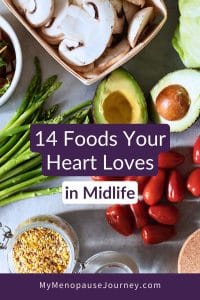
Table of Contents
The Cardiovascular System: A Quick Overview
The cardiovascular system is made up of the heart, the blood vessels (arteries, veins, and capillaries), and the blood itself. Its job is to carry nutrients and oxygen everywhere they’re needed and to clear waste away.
For both men and women, CVD is the leading cause of death worldwide. Rates have improved thanks to better diagnosis, prevention, and treatment — yet one in three US women still dies of heart disease, and more women than men die from CVD overall.
So what are the early signs and symptoms?
- Tiredness and fatigue
- Loss of appetite
- Nausea
- Confusion, foggy thinking, brain fog, or memory slips
- A racing heart or palpitations
- Shortness of breath
- A persistent cough or wheeze
- Swelling in the feet, ankles, legs, or belly from fluid building up in body tissues
- Weight gain
And just so we’re on the same page — what exactly counts as cardiovascular disease? It’s any condition involving the heart (cardio) or the blood vessels (vascular). The most common include coronary heart disease, cerebrovascular disease (which affects blood flow to the brain), peripheral arterial disease, congenital and rheumatic heart disease, deep vein thrombosis, and pulmonary embolism.
What Makes Menopausal Women More at Risk?
Menopause stirs up so many changes — but it’s not witchcraft! The risk of CVD rises with age in women just as it does in men; it simply starts climbing a little later for us. One of the biggest reasons is falling estrogen. (If you want the full story on how this works, I’ve put it all in one place: menopause and your heart. And here’s a newer twist worth knowing — frequent or severe hot flashes are now linked to a less heart-friendly profile, so they can be a quiet signal, not just a nuisance.)
You might not have expected that, but yes — lower estrogen can raise our heart risk. Let me break it into crumbs, starting with cholesterol.
Cholesterol is a waxy, fat-like substance found in every cell. Your total cholesterol includes LDL (the “bad guy”), HDL (the “good guy”), and triglycerides (another blood fat that can raise risk).
Women’s total cholesterol tends to rise after menopause, often peaking between 55 and 65 — about ten years later than in men. Estrogen normally works with the liver to nudge HDL up and LDL down. So when estrogen drops, that built-in protection fades, and risk creeps up.
So again I’ll say it: hormonal balance, smart eating habits like fasting, and an active lifestyle go a long way toward keeping serious disease at bay. Ask anyone who works in functional medicine — they’ll point you straight to these everyday levers.
How Does Diet Affect Your Cardiovascular Health?
“Diet is vital” sounds as obvious as “life is short.” But here’s some of the science behind it — and as you read, try taking honest stock of your own habits.
- More than two-thirds of heart-disease deaths worldwide are linked to food choices, and researchers estimate millions of deaths could be avoided through better eating.
- The traditional Mediterranean-style way of eating — mostly plants and plant proteins — is one of the best-tested patterns for lowering CVD risk.
- One large US analysis tied hundreds of thousands of cardiometabolic deaths to poor diet — too few nuts, seeds, fruits, vegetables, and seafood omega-3s, and too much processed meat.
The Truth About Salt — and It’s Not the Lecture You’re Expecting
For decades we were told one thing: salt is bad, cut it, full stop. The science turned out messier. Both very high and very low sodium are linked to worse heart outcomes — more of a U-shaped curve than a straight line — and severe restriction can actually stress the body’s hormones. Functional-medicine voices like Mark Hyman and Chris Kresser have made this case for years, and the research has been catching up.
Here’s what actually matters. Most of our sodium doesn’t come from the salt shaker — about three-quarters of it hides in processed food: bread, sauces, deli meat, packaged everything. And the real seesaw isn’t sodium alone, it’s sodium versus potassium. We evolved eating far more potassium than sodium; modern life flipped it. So the heart-smart move is less processed food and a lot more potassium — the kind in vegetables, fruit, beans, and potatoes.
So what about the salt you do reach for? Choose an unrefined one — Himalayan pink or Celtic. The honest reason isn’t a mineral jackpot (those trace minerals are real, but tiny — even the functional-medicine crowd admits that). It’s that unrefined salt skips the additives in standard table salt, like anti-caking agents, and is simply a cleaner product. One caveat: table salt is also where many of us get our iodine, so if you switch, get yours elsewhere — seafood, dairy, sea vegetables.
And if you fast or eat low-carb — as so many of us here do — this matters even more. When you fast or cut carbs, your body flushes out more sodium and water, which is often what’s behind the cramps, the fatigue, that foggy “off” feeling. Replenishing with a good pinch of quality salt, plus potassium and magnesium, is one of the simplest ways to feel steady again. Your electrolytes are doing real work — give them what they need.
And Then There’s Sugar
Sugar I’d put near the very top of this list. It’s not only the inflammation — though there’s that too: according to Johns Hopkins Medicine, chronic inflammation helps drive the plaque growth and clots behind heart attacks and strokes. It’s what sugar does to your metabolism. Too much of it — especially the added sugar hiding in “healthy” yogurts, sauces, and snack bars — nudges your body toward insulin resistance, the quiet engine behind metabolic syndrome: the belly fat, the creeping blood pressure, the rising triglycerides, the blood sugar that won’t behave.
Robert Lustig, the UCSF endocrinologist who’s spent his career on this, puts it bluntly — the real culprit isn’t cholesterol or calories, it’s insulin resistance, and sugar feeds it. In midlife, when our insulin sensitivity is already shifting, this matters even more. The upside? It’s also one of the most reversible things on this whole page.
So if you want to protect your heart, a powerful place to start is calming inflammation and steadying your blood sugar through what’s on your plate. Which brings us to the good part!
What Are the Best Heart-Healthy Foods?
Go for healthy fats, quality protein, and plenty of plants — the backbone of the Mediterranean way of eating. Here are foods to keep your cardiovascular health in tip-top shape:
- Fish rich in omega-3 fatty acids: salmon, tuna, mackerel, herring, trout
- Healthy nuts: almonds, walnuts, cashews, pistachios, hazelnuts
- Berries — full of heart-friendly phytonutrients and soluble fiber
- Seeds (omega-3s, fiber, protein, phytoestrogens): flaxseeds, chia, sunflower, pumpkin
- Legumes (fiber, B-vitamins, minerals): beans, lentils, chickpeas
- Leafy greens: spinach, kale, chard, collards, bok choy, broccoli, arugula
- Dark chocolate (the higher the cocoa, the better)
- Avocados — rich in heart-healthy monounsaturated fats
- Fresh herbs and aromatics: garlic, turmeric, basil, cilantro
- Plant-based oils: olive and avocado
- Shellfish, eggs, and lean poultry
- Pomegranate — flavonoids that may help protect against artery disease
Want recipes to put this on a plate? Try my easy salad recipes or a Buddha bowl — both lean exactly this way.
And when food alone leaves a gap, a few vitamins and supplements can support the heart:
One honest note: omega-3, magnesium, CoQ10, and vitamin D have the most research behind them here. A few of the others are more “promising” than “proven” — so don’t feel you need the whole shelf. Food first; supplements to fill real gaps.
More Ways to Promote Women’s Cardiovascular Health
1 – Know your risk, and know your power. Some things you can’t change: age, sex, family history. But here’s what I wish more women heard — your genes are not your destiny. They load the gun; your daily life decides whether it ever goes off. I’ve lost count of how often I’ve heard, “oh, heart trouble runs in my family, there’s nothing I can do.” That’s just not true. The conditions you can influence, the habits you build, the stress you carry — that’s where the real power sits.
2 – Get moving. Both strength work and walking lower heart risk, lift your energy, and help with weight and cholesterol.
3 – Keep a weight that feels good and works for your body. Carrying extra weight around the middle raises the risk of high blood pressure, type 2 diabetes, and heart disease — so gentle, doable shifts here pay off for your heart, not for a number on the scale.
4 – Bury the bad habits. Too much alcohol and any smoking raise blood pressure and heart risk — and secondhand smoke counts too.
5 – Protect your sleep. Most of us need at least seven hours. Skimping over time is hard on the heart, not just the mood. So don’t be shy about sleeping like a baby — your sleep is heart medicine.
6 – Take stress as seriously as you take food. We talk endlessly about what’s on our plate — and nowhere near enough about the pressure we live under. Chronic stress isn’t background noise; it keeps your body in fight-or-flight, quietly pushing up blood pressure, blood sugar, and inflammation. For your heart, it belongs right up there with diet.
Everyone’s “on” all the time now — chasing, comparing, keeping up. I stepped off that treadmill years ago. My husband and I made “less is more” our whole philosophy: we sold the big house, stopped buying things we didn’t need, and traded it all for more time — to breathe, to travel, to actually live. It’s one of the most heart-healthy decisions I’ve ever made, and no doctor prescribed it. Whatever “less is more” looks like for you — fewer obligations, more white space, one honest “no” — your heart is listening.
✔️ Friendly tip: heart symptoms often look different in women than in men, and most heart drugs were tested mostly on men. Women have long been at a disadvantage here, partly because the “classic” symptom everyone’s taught is chest pain. We’re more likely to feel nausea, dizziness, jaw or neck pain, or a sore back. So trust yourself, and speak up.
A Word on Medications: Know Your Numbers
How heart attacks and strokes happen: atherosclerosis is when “plaque” — fatty deposits and LDL cholesterol — builds up in the artery walls and narrows them. If a clot forms on that plaque and blocks blood flow, the result can be a heart attack or stroke.
Statins are the go-to prescription for lowering cholesterol, and for some women they’re genuinely worth it. But here’s something we’re almost never handed: a way to understand how much a drug is likely to help you. It’s called the Number Needed to Treat (NNT) — how many people have to take a drug for one person to benefit — and its twin, the Number Needed to Harm (NNH).
Why it’s worth knowing: the benefit of statins depends a lot on whether you’ve already had heart trouble.
- If you’ve already had a heart attack or stroke (what doctors call secondary prevention), statins clearly help — over five years they measurably lower the chance of dying, having another heart attack, or a stroke.
- If you haven’t (primary prevention), the picture is smaller. In the numbers from TheNNT, a physician-run evidence project, roughly 1 in 100 people taking a statin for five years avoids a heart attack and about 1 in 150 avoids a stroke — with no clear drop in overall deaths in that group — while a minority develop new diabetes or muscle aches.
None of this means “don’t take your statin.” It means you get to ask a better question: given my history, what’s the benefit for someone like me — and what are the trade-offs? That’s not anti-medicine. That’s being in the driver’s seat of your own care.
One more thing worth raising with your doctor: statins can lower your body’s CoQ10, a nutrient your heart cells use for energy. Some women find a CoQ10 supplement eases statin-related muscle aches — the evidence is mixed, but it’s a fair thing to ask about.
(I’m not a doctor, and this isn’t medical advice — it’s the context that helps you have a real conversation.)
Takeaway
I hope you can feel how much your plate — and your pace of life — matter here. Care for your cardiovascular health, especially in menopause: eat real food that loves you back, move in ways you enjoy, sleep, and breathe. Try the recipes, lean on the foods above, ease the pressure where you can — and never forget the emotional side of your heart, too. Breathe. Feel every beat of it. Appreciate how it keeps you here for every moment.
References:
Heart disease facts – CDC (cdc.gov)
Menopause and heart disease – American Heart Association (heart.org)
Cardiovascular disease in women, scientific statement – American Heart Association (ahajournals.org)
Fight inflammation to help prevent heart disease – Johns Hopkins Medicine (hopkinsmedicine.org)
How estrogen affects heart health – Cleveland Clinic (my.clevelandclinic.org)
Added sugar intake and cardiovascular disease mortality – JAMA Internal Medicine (jamanetwork.com)
Dietary sugars intake and cardiovascular health, scientific statement – American Heart Association (ahajournals.org)
Sodium intake and cardiovascular events, pooled analysis – PubMed (pubmed.ncbi.nlm.nih.gov)
Potassium and blood pressure – American Heart Association (heart.org)
Statins for heart disease prevention – TheNNT (thennt.com)
Dietary factors and cardiometabolic deaths – JAMA (jamanetwork.com)
Mediterranean diet and cardiovascular disease – PubMed (pubmed.ncbi.nlm.nih.gov)
Dyslipidemia in menopause – PubMed (pubmed.ncbi.nlm.nih.gov)
Nutritional supplements and cardiovascular health – PubMed (pubmed.ncbi.nlm.nih.gov)

Gita is the founder of My Menopause Journey. Since 2014, she has been supporting midlife women by sharing hard-earned learnings from her own experience. To advance her knowledge, Gita puts a lot of her time and effort into understanding the broad spectrum of women’s health. She immerses in extensive research about the physical, mental and emotional aspects of menopause. Gita believes in the life-changing power of healthy, holistic living — this is where she anchors her message to all women. Learn more about her marvelous mission in About us - My Menopause Journey.