As a youngster, I didn’t really understand the importance of eating well. Staples at our house were sandwiches and cinnamon buns — that was my idea of “hungry, fix it now.” It took losing my parents far too early for me to get obsessed with the connection between food, gut, and brain. These days I eat low-carb — which doesn’t mean I’ll say no to a croissant now and then — and the right vitamins and minerals for menopause have made this whole transition so much steadier.
Here’s the honest version, woman to woman: food is your number one source. Supplements are backup, not a substitute — a pill will never replace a plate. And while there are dozens of nutrients that matter, a handful really pull their weight in midlife. Those are the ones I want to walk you through.
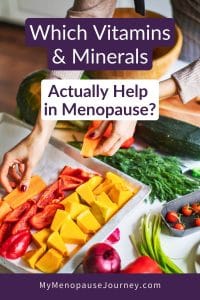
Table of Contents
Vitamins vs. minerals — what’s the difference?
We tend to lump them together, but they’re not the same thing.
Vitamins are organic compounds made by living things — plants and animals. They’re fragile: air, heat, and acid break them down, which is partly why so much is lost between the field and your fork.
Minerals are inorganic — they come from the earth. Plants pull them up from the soil, animals eat the plants, and that’s how they reach us. Minerals are sturdier and hold up better to cooking.
In a perfect world we’d get everything we need from what’s on our plate. But modern, processed-heavy eating, a stressful life that burns through reserves faster, and a gut that absorbs less efficiently as we age all mean a lot of us fall a little short — right when our bodies are asking for more support.
In menopause, these nutrients don’t “make hormones for you” — but they’re the raw materials and helpers your body leans on for energy, mood, sleep, bone strength, and keeping your nervous system off the ceiling. When you’re running low, midlife tends to feel louder.
The vitamins and minerals for menopause that matter most
I’ve handpicked the ones worth knowing — what each does for you now, where to get it from food, and where to be a little careful.
B vitamins (especially B6, B9, and B12)
The B’s are your energy, mood, and nerve crew. B6 and B12 help your body make the brain chemicals that steady mood swings and ease anxiety, and B12 matters more after 40 because we absorb it less well — especially if you eat little meat or take acid-reducing meds. Find them in eggs, fish, shellfish, poultry, leafy greens, legumes, and whole grains.
Read my full guide to all eight B vitamins for midlife →

Vitamin C
A genuine antioxidant that helps you build collagen, absorb iron, and support your immune system. You’ll get plenty from citrus, berries, bell peppers, broccoli, Brussels sprouts, and cabbage. It’s water-soluble, so your body sheds the excess.
Read my full vitamin C guide →
Vitamin D
Technically a hormone, not just a vitamin — and one of the big ones for midlife bones, because it’s what lets your body actually use the calcium you eat. Most of us make it from sunlight; food sources include fatty fish, egg yolks, and fortified foods. It’s fat-soluble, so it builds up — this is one where more is genuinely not better (see the upper-limits section below).
Read my full vitamin D guide →
Calcium
Bone health gets all the headlines here, and decreasing estrogen does speed up bone loss after menopause. But this is a food-first nutrient — leafy greens, sardines, salmon with bones, and plenty of plant sources do a lot of the work, and it teams up with vitamin D and K2 for absorption. Mega-dosing supplements isn’t the win it was once sold as.
Magnesium
If I had to pick a quiet hero, this is it — sleep, mood, muscle relaxation, blood sugar, the works. Dark chocolate, avocados, nuts, seeds, legumes, and leafy greens are your friends.
Read my full magnesium guide →
Vitamin A
Vitamin A keeps your eyes, skin, and immune system in good shape. You get it two ways: “preformed” retinol from animal foods (liver, eggs, dairy) and beta-carotene from orange and dark-green vegetables (sweet potato, carrots, kale, chard) that your body converts as needed.
The catch: preformed retinol is fat-soluble and accumulates, so high-dose supplements can tip into toxic territory. Beta-carotene from food doesn’t carry that risk — your body just converts what it needs. So lean on the vegetables, and go easy on high-dose A pills.
Vitamin E
An antioxidant that protects your cells and supports skin and immune health. Nuts, seeds, avocado, spinach, and good oils have you covered. You almost never need to supplement it — and high-dose E capsules are one to be cautious with rather than take “just in case.”
Vitamin K
The one that directs calcium to your bones instead of your arteries — which is exactly what you want in midlife. K1 lives in leafy greens; K2 in fermented foods, egg yolks, and some cheeses. One heads-up: if you take blood thinners like warfarin, talk to your doctor before changing your K intake, because it affects how the medication works.
Potassium
Potassium helps steady blood pressure and fluid balance and keeps muscles (including your heart) working smoothly — and most of us get too little. There’s a midlife twist, too: as progesterone (a natural diuretic) drops in perimenopause, fluid can linger and leave you puffy, and potassium is part of how your body manages that balance. It matters for the long game as well — in postmenopausal women, a higher potassium intake has been linked to a lower risk of stroke. Beans, potatoes, leafy greens, avocado, and fruit are easy sources. Skip high-dose potassium supplements unless a doctor has told you to, especially if you have kidney or heart concerns.
Zinc
Zinc is a busy little mineral — immune function, skin, taste, and a hand in plenty of enzyme and hormone work. Oysters are the famous source; meat, pumpkin seeds, and legumes do the job too. Watch the supplements: too much zinc for too long actually blocks copper, so more is not better here either.
Iodine
Iodine is the building block your thyroid uses to make its hormones — and the thyroid loves to act up in midlife. Here’s a catch worth knowing: a sluggish thyroid causes many of the same things menopause does — fatigue, brain fog, dry skin, thinning hair, feeling cold, stubborn weight — so it’s easy to write a thyroid problem off as “just menopause,” and worth asking your doctor to check if those symptoms linger. And here’s the nuance most articles skip: both too little and too much iodine can throw your thyroid off. Iodized salt, seafood, and dairy cover most of us. If you’re reaching for kelp or seaweed supplements, go gently and check with your doctor, especially if you already have a thyroid condition.
Selenium
A trace mineral that backs up your antioxidant defenses and helps your thyroid convert its hormones. Brazil nuts are so rich in it that one or two a day is plenty — and worth knowing, because selenium has a narrow safe window and tips into toxic faster than most. Seafood and eggs are gentler sources.
Omega-3 (a quick honorable mention)
Not technically a vitamin or mineral — they’re fatty acids — but they belong in any midlife conversation about feeling steady, for heart, brain, and mood. Fatty fish, flax, chia, and walnuts are the way in. More on omega-3 and omega-6 here →
How much do you actually need — and how much is too much?
This is the part I wish someone had spelled out for me, because “take your vitamins” makes it sound like there’s no ceiling. There is.
Two numbers matter. The RDA is roughly what you need each day to function well. The UL (upper limit) is the most you can take before side effects become a real risk. Food almost never pushes you past the UL — supplements absolutely can, because they’re concentrated.
The nutrients to respect most are the fat-soluble vitamins — A, D, E, and K — because they’re stored rather than flushed, plus minerals like iron, zinc, iodine, selenium, and calcium. Megadosing any of these isn’t a shortcut to better health; it’s how you end up with the opposite. The water-soluble ones (the B’s and C) are more forgiving since you pass the excess — but “more forgiving” still isn’t “unlimited.”
My rule of thumb: get the bulk from food, add one supplement at a time so you can tell what’s doing what, and check with your doctor before anything high-dose — especially if you take medication. For the official per-nutrient amounts and upper limits, the NIH Office of Dietary Supplements fact sheets are the clearest, no-spin source I know.
A friendly reminder: it all comes back to the gut
You can eat beautifully and still come up short if your gut isn’t absorbing well — and midlife digestion gets temperamental. Feed it: whole, plant-forward food, fiber, fermented foods, enough water. Slow down, breathe, and move every day to keep things running. If your gut’s been struggling, start there before you load up on pills.
Not sure where your symptoms are even coming from? My free 5-Minute Menopause Map helps you sort out what’s hormones, what’s nutrition, and what’s worth acting on first.
Fact box: the two types of each
Water-soluble vitamins dissolve in water and aren’t stored for long, so you need them topped up regularly: the eight B vitamins and vitamin C. (B12 is the exception — your liver can hold a reserve for a good while.)
Fat-soluble vitamins — A, D, E, and K — are stored in your fat tissue and stick around, which is exactly why toxicity is possible if you over-supplement them.
Macro minerals (you need more): potassium, magnesium, calcium, phosphorus, sodium. Trace minerals (smaller amounts, just as important): iron, iodine, selenium, zinc, chromium.
Food is medicine — Hippocrates said it 2,500 years ago and he wasn’t wrong. A wide, colorful, whole-food plate is still the best multivitamin there is. Supplements are the fertilizer, not the soil.
References
ods.od.nih.gov — Dietary Supplement Fact Sheets (Vitamin A, D, E, K, C, B12, Calcium, Magnesium, Potassium, Zinc, Iodine, Selenium)
Office of Dietary Supplements — Nutrient Recommendations: Dietary Reference Intakes (RDA and UL tables)
Mayo Clinic — Vitamins and supplements; Cleveland Clinic — Nutrition in menopause
Harvard T.H. Chan School of Public Health, The Nutrition Source — Vitamins and Minerals

Gita is the founder of My Menopause Journey. Since 2014, she has been supporting midlife women by sharing hard-earned learnings from her own experience. To advance her knowledge, Gita puts a lot of her time and effort into understanding the broad spectrum of women’s health. She immerses in extensive research about the physical, mental and emotional aspects of menopause. Gita believes in the life-changing power of healthy, holistic living — this is where she anchors her message to all women. Learn more about her marvelous mission in About us - My Menopause Journey.