There’s a knobbly little root in my kitchen I reach for more than almost anything else. When women ask me about ginger benefits for menopause, I just point at it.
It’s not glamorous. It’s not trendy. It honestly looks like something you’d dig out of the garden and toss aside.
But grate a little into hot water on a day when your tummy’s churning or your knees feel creaky — and you’ll understand why I keep it within arm’s reach. This humble root has been a woman’s friend for thousands of years, and midlife is exactly when it earns its keep — not as a cure, but as a warm, reliable helper for the small daily stuff.
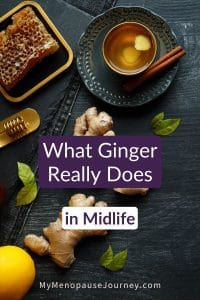
Table of Contents
Why ginger earns its spot in midlife
Ginger isn’t new. Women have leaned on this knobbly root for thousands of years — for sore tummies, achy joints, and queasy mornings.
So why does it matter now? Midlife turns up the body’s background “noise.” Low-grade inflammation creeps in. Digestion gets touchier. Blood sugar swings more easily. Aches settle where they didn’t used to.
Ginger works with your body on exactly those things. Its active compounds (called gingerols) are warming and anti-inflammatory. They calm, they soothe, they get things moving. That’s the whole idea behind the ginger benefits for menopause — gentle support, right where midlife tends to poke at you.
The real ginger benefits for menopause
Let’s get specific. Here’s where the ginger benefits for women actually show up, day to day.
Calmer aches and stiffer joints
This is ginger’s strong suit. Because it cools inflammation, it can take the edge off the achy, stiff feeling that creeps into midlife joints. Studies on knee pain back this up — ginger eased pain and stiffness for a lot of people, gently. It won’t replace what your doctor gives you for arthritis. But as everyday support? Lovely.
A calmer, less bloated tummy
Ginger and digestion go way back. It nudges your stomach to empty a little faster and helps settle that heavy, bloated feeling after meals. If midlife has made your tummy moodier — so common, you’re in good company — a little ginger with food helps things tick along.
Easier periods — if you’re still having them
Still cycling through perimenopause? Ginger is genuinely good for period pain. In studies, taking it during the first few days of your period eased cramps about as well as common painkillers did. A warm mug of ginger tea on day one isn’t just comforting — it’s doing real work.
Steadier blood sugar
Midlife can make blood sugar bouncier, which feeds that tired-and-cravy cycle. Ginger may help: several studies show it can nudge fasting blood sugar and longer-term levels in a better direction, and support how your body handles insulin. The evidence is mixed and the effect is gentle — so it’s a helper alongside good food and movement, not a stand-in for them.
Those queasy, “off” mornings
If there’s one thing ginger is famous for, it’s settling a queasy stomach. It’s one of the best-studied natural remedies for nausea there is. Midlife can bring the odd wave of queasiness or light-headedness, and ginger — tea, a few slices in hot water, even a piece of crystallized ginger — is a kind, simple thing to reach for.
How much ginger — and the easy ways to use it
Good news: you don’t need pills to get the ginger benefits for menopause. Food and tea do beautifully.
Fresh root — grate it into stir-fries, soups, dressings, or hot water. A thumb-sized piece a day is plenty.
Ginger tea — a few slices in hot water, maybe with lemon and honey. My go-to on a bloated or queasy day.
Ground ginger — easy in porridge, baking, or a smoothie.
Two practical notes: a little most days beats a big hit now and then. And if you’re using it for period pain, start on day one and keep it going for three or four days. Most people do well with up to about 3–4 grams a day from all sources (roughly a couple of teaspoons of fresh) — no need to go higher.
Ginger also loves company. It works beautifully alongside its anti-inflammatory cousin, turmeric — a pinch of each in warm milk or a soup is a cozy midlife habit.
Is ginger safe to take every day?
For most of us, yes — and the food-and-tea amounts are very safe, with a long, friendly track record.
A few honest heads-ups, mostly if you reach for concentrated supplements or you’re on medication:
- On blood thinners, or heading into surgery? Ginger can thin the blood a little — check with your doctor, and ease off before an operation.
- On blood-sugar or blood-pressure medication? Ginger can nudge both down. Usually welcome, but worth keeping an eye on so nothing dips too low — a quick word with your doctor covers it.
- Gallstones? Ginger gets your bile moving, so go gently and ask first.
- Big doses can bring mild heartburn or an unsettled tummy. If that’s you, scale back — more isn’t better.
The short version: enjoy ginger freely in your cooking and tea. Treat high-dose supplements with a bit more care, especially if you take medicine. If you like a level-headed second opinion, the NCCIH has a good plain-language summary.
So, is ginger worth it in midlife?
If your days come with achy joints, a touchy tummy, or the odd queasy, sluggish patch — then yes, absolutely.
It’s not flashy. It won’t undo menopause. But the real ginger benefits for menopause are the quiet, everyday kind: one of those reliable superfoods that makes the ordinary day a little easier — and it’s been doing it for women for centuries.
And if you’re still piecing together which midlife changes are even yours — what’s hormones, what’s just life — my free 5-Minute Menopause Map is a gentle place to get your bearings.
References:
Ginger: Usefulness and Safety – NCCIH (nccih.nih.gov)
Ginger health benefits – Cleveland Clinic (clevelandclinic.org)
Effectiveness of ginger on pain and function in knee osteoarthritis: meta-analysis – PubMed (pubmed.ncbi.nlm.nih.gov)
Ginger for primary dysmenorrhea: systematic review & meta-analysis – PMC (pmc.ncbi.nlm.nih.gov)
Ginger and glycemic control in type 2 diabetes: meta-analysis – PMC (pmc.ncbi.nlm.nih.gov)
Ginger for nausea and vomiting: review – PMC (pmc.ncbi.nlm.nih.gov)
Ginger bioactives: a review of health benefits – Antioxidants / PMC (pmc.ncbi.nlm.nih.gov)

Written by Gita — Certified Fasting Therapist, Nutrition Coach and Keto Coach, and founder of My Menopause Journey since 2014. Every article is built on published research and trusted health sources, updated regularly, and shaped by her own journey through menopause. Read more about Gita and her credentials.