
Approaching the grand finale of our reproductive years (a.k.a. menopause) really brings unpredictable changes to our body, doesn’t it? Some are downright noticeable, others are not — and a few can be alarming.
For instance, heart palpitations. One minute you’re fine, the next your heart is pounding, racing or doing a strange little flip in your chest — sometimes out of nowhere, sometimes in the middle of the night. It’s your heart telling you something has shifted. Most of the time it’s hormones, stress or that extra cup of coffee. But in the moment, it can feel like the scariest thing in the world.
Palpitations are common in menopause, and they are usually not harmful. Several triggers can make your heart pound in midlife — including hormonal fluctuations, hot flashes, stress, anxiety, lack of sleep, dehydration, caffeine and dietary factors. In some cases, palpitations could also be a sign of an underlying condition.
I haven’t had much of the fluttery kind myself. But now and then, my heart pounds harder than it used to. It doesn’t last long, and I notice it most after a social evening with good food and a few drinks. And yes, that counts as palpitations too! One of my sisters had palpitations that scared her so much she called 911. And I get it. When your heart suddenly goes wild and you have no idea what’s going on inside your body, it’s frightening.
That’s why I wanted to write this. So you know what’s usually behind it, what calms it down, and when to get checked. And if something feels wrong, get a checkup. Always. That’s never overreacting.
Here’s something reassuring, though. One big study followed thousands of midlife women for years (it’s called SWAN). About half of them had a real chance of getting palpitations during perimenopause and early postmenopause. For most, they faded by late postmenopause. And heart palpitations in menopause weren’t linked to clogged or stiff arteries.
Heart racing right now? Try this:
- Sit down and breathe slowly: in through your nose for a count of 4, out through your mouth for a count of 6.
- Splash cold water on your face, or sip a glass of cold water.
- If it comes with chest pain, shortness of breath or feeling faint, call 911 now.
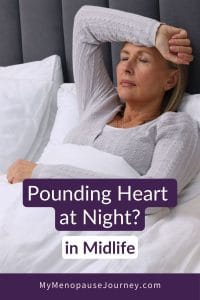
Table of Contents
What Do Heart Palpitations Feel Like?
Heart palpitations feel like your heart is thumping, racing or fluttering. Sometimes, you will feel the sensation throughout your chest — almost like you can hear your heartbeat. The discomfort may also extend to the neck region.
Okay, now, if your heart seemed to skip a beat after a romantic dinner, you’re totally fine. (And if so, kudos to your hubby!) If your heart palpitates after a fleeting moment of excitement, anxiety or fear, there’s nothing to worry about either. We commonly know that as an “adrenaline rush” — it’s when your fight-or-flight brain chemicals make your heart pump hard.
However, if palpitations occur without a direct reason or stimuli, it could be due to other factors. Most palpitations are over in seconds. If yours last more than a few minutes, or keep coming back more often, it’s worth getting checked, so you know what’s behind them.
What Causes Heart Palpitations in Menopause?
I understand that experiencing palpitations can be scary. Fortunately, these sensations are usually not harmful! However, it still pays to be knowledgeable and aware. Listening to your body when it tells you something can save you from heart-related issues like palpitations!
One of the primary reasons behind heart palpitations in menopause is hormonal fluctuations. Other factors include stress, anxiety, lack of sleep, dehydration, caffeine, alcohol and dietary factors. Less often, heart palpitations may also result from health conditions such as high blood pressure, low blood sugar levels, overactive thyroid, low potassium, anemia, heart rhythm problems or risk of cardiovascular disease.
Read more so you’ll know how these triggers affect our heart health!
1. Hormonal Changes
Our hormones naturally fluctuate as we age — and those hormonal changes can reach your heart, too. And what hormones are linked to heart palpitations in menopause? Progesterone and estrogen! Here’s how they affect our heart health:
✅ Progesterone: This is the first hormone that declines when we enter perimenopause – the first stage of menopause. When progesterone’s balance gets tipped off, it can have a ripple effect and lead to many symptoms – including palpitations!
Moreover, progesterone is known for its ability to “tame” the wild side of estrogen. Yup, estrogen and progesterone have opposing effects! Therefore, without enough progesterone to keep estrogen’s effects at bay, our emotions can go up and down, left and right!
Here’s why. Progesterone has a calming effect on GABA, the brain’s own “chill-out” chemical. When progesterone drops, you lose some of that calm, so you can feel jittery, anxious or wired. Swinging estrogen also nudges serotonin (a feel-good brain chemical) up and down. All of this keeps your nervous system on alert, and a nervous system on alert can make your heart race.
✅ Estrogen: Estrogen is believed to have heart-protective qualities by maintaining the elasticity of the arteries. It also helps regulate cholesterol levels and facilitate any changes in blood flow! Therefore, the decline in estrogen during menopause makes the blood vessels less elastic — making it more likely for plaque and blood clots to form. Also, our heart has to work a little harder when the blood vessels aren’t smooth and relaxed. And during a hot flash, your heart rate can jump too, which is why palpitations and hot flashes so often show up together! Furthermore, growing studies show that low estrogen is one of the risk factors of cardiovascular disease among women.
2. Emotional Stress
The emotional highs and lows of our menopausal life can activate our body’s fight-or-flight response. This stress response can speed up our heart rate! Our blood flow increases, giving us a burst of energy to either “fight” or “run from danger”.
Strong emotions also release adrenaline, which tightens your blood vessels and pushes your heart to beat faster and harder. Therefore, we might notice palpitations as the immediate physical reaction when we’re scared, nervous or anxious! That’s why learning how to deal with stress is good for your heart, too.
3. Lack of Sleep
We all have late-night thoughts. Many menopause symptoms also keep us up at night – making us sleepless!
Generally, poor sleep quality, including abrupt awakenings, can cause a sharp increase in heart rate. Research also found that women with sleeping problems are more likely to complain of an irregular heartbeat! For these reasons, lack of sleep is tied to heart palpitations in menopause.
4. Dehydration
Dehydration can cause heart palpitations because blood contains water. Any decline (no matter how small) in the amount of water in the bloodstream can have a drastic effect on our body! Remember, our body functions rely greatly on the delicate balance between nutrients and fluids.
So, when you’re dehydrated, there’s less fluid in your blood. Your heart makes up for it by beating faster to keep everything moving. This can increase your pulse rate and potentially lead to palpitations.
5. Caffeine, Alcohol, Nicotine and Some Medicines
These are some of the most common everyday triggers, and midlife can make you more sensitive to them. That second (or third!) coffee, energy drinks, a glass of wine, and smoking or vaping can all make your heart race.
Some medicines can do it too. Think cold and flu pills with decongestants, asthma inhalers, diet pills, and too much thyroid medicine. If you started something new and then the palpitations began, tell your doctor. But don’t stop a prescribed medicine on your own.
6. Underlying Health Conditions
Typically, heart palpitations in menopause are harmless. However, if you have already tried many remedies or techniques but the palpitations persist, they may be a warning signal of certain health conditions:
- High Blood Pressure (hypertension)
- Low Blood Sugar Levels (hypoglycemia)
- Overactive Thyroid (hyperthyroidism)
- Low Potassium
- Over-breathing (hyperventilation) during anxiety or panic
- Anemia (low iron)
- Heart rhythm problems, such as atrial fibrillation (more on that below)
- Risk of Cardiovascular Disease
A quick word on your thyroid, because it’s easy to miss. An overactive thyroid speeds everything up, including your heart. Graves’ disease is the most common cause. Too much iodine (from kelp pills, for example) or too much thyroid medicine can do it too. So if you take thyroid medicine and your heart starts racing, ask for a blood test. Your dose may need adjusting. Never stop or change thyroid medicine on your own!
“Sometimes, comfort and reassurance are the simplest and best medicine.”
Estrogen, Progesterone and Heart Palpitations in Menopause
While our hormones naturally decline in midlife, heart palpitations typically go away after menopause (when estrogen levels have become more stable)! That big study I mentioned backs this up: for most women, palpitations faded by late postmenopause.
But during perimenopause, your ovaries start to falter. Progesterone goes down first, while estrogen stays up or swings around. With enough estrogen and less progesterone, an imbalance in ratio takes place, almost like a see-saw situation! This is often called estrogen dominance (ED). It’s a functional-medicine way of describing the see-saw, not an official diagnosis — but the up-and-down pattern it describes is very real.
Estrogen also talks to your body’s “autopilot”, the part of your nervous system that sets your heart rate without you thinking about it. When estrogen swings up and down, that autopilot gets jumpy. Your fight-or-flight side can take over more easily, so your heart speeds up and you notice every beat. Add a hot flash or a stressful day, and heart palpitations in menopause show up.
Here’s Dr. Heather Hirsch, a menopause doctor, explaining more about the link between hormones and heart palpitations in menopause:
Why Do I Experience Heart Palpitations After Eating?
Some women report that they experience palpitations only after they eat. Do palpitations have something to do with food?
Personally, I experience heart palpitations every time I eat sugary foods or have a glass of wine. I am a healthy eater, but once in a while, I get cravings and head to the candy store! After giving in to my sweet tooth, I can almost hear my heart’s frustration as it sounds like a bass drum. There’s a reason for that: a big hit of sugar sends your blood sugar up and then crashing down. And when it crashes, your body releases adrenaline to fix it. Hello, pounding heart!
Generally, heart palpitations after eating can be due to chewing, swallowing and digestive processes. Remember, everything in our body is connected so, it could be a little traffic jam situation. Give your food some time to settle, chew thoroughly, eat mindfully and breathe!
Heart palpitations after eating could also be triggered by the kind of foods you eat. In midlife, our heart and body become increasingly sensitive to foods that don’t serve us!
Everyone’s triggers are different, but these are the ones that come up most often:
- Caffeine (coffee, black and green tea, energy drinks)
- High-carbohydrate foods
- High-sodium foods (processed foods)
- High-sugar foods
- Spicy or rich foods (which can cause heartburn)
- Alcohol
- Monosodium glutamate (MSG)
- Theobromine (found in chocolate)
- Tyramine (found in aged cheese, cured meats and wine)
Therefore, avoid these foods and eat heart-healthy foods instead! Check out my article for a great list of foods that will support your heart health!
When buying food products, be mindful of the labels too! There are so many hidden things, so play detective and go over the ingredients list. Watch out if any of the ingredients above are in the product you’re about to buy!
Heart Palpitations at Night: Is This Normal?
Experts say that having heart palpitations at night are common and should not cause worry. Palpitations can happen at any time — even if you are resting or doing normal activities.
If you get palpitations at night, it is probably because you are more likely to notice palpitations when you are not distracted. It could also be due to stress or anxiety — both common symptoms in menopause that can make your heart beat faster! And night sweats can set them off too.
Some women may also get heart palpitations when lying down, especially those who sleep on their left. On your left side, your heart sits closer to the chest wall, so you feel every beat more. Try rolling onto your back or right side and see if it settles.
How to Relieve Heart Palpitations Naturally
Besides eliminating food triggers and eating a hormone-balancing diet, you can also relieve heart palpitations in menopause with a few natural remedies! Here are the best habits you can do to make your heart happy:
✅ Good Sleep Quality: Get 7-9 hours of quality sleep. It’s a great time for your body to recover and have a mental detox!
✅ Low-Impact Exercises: Yoga, Pilates and qigong are great low-impact exercises that help improve blood circulation. These exercises also promote heart health and boost mental stability!
✅ Meditation and Stress Management: Yup, we can’t get rid of stress entirely. But there are things we can do to manage it! For one, meditation is a proven tool for effective stress management. You can also do any stress-busting activity that enriches your mind, body and heart!
✅ Deep Breathing: Deep breathing helps you relax and ease the stress and anxiety that can come with palpitations. Ultimately, it is a good practice to integrate into your life! Calming yourself down and taking slow, deep breaths can effectively regulate your heart’s rhythm and trigger the release of your happy and calming hormones!
✅ Simple Breathing Exercise: Sit quietly and close your eyes. Place one hand on your abdomen. Breathe slowly and deeply through your nose. Feel your abdomen move outward. Exhale through your nose or mouth (whichever feels more comfortable). Repeat until you normalize the heartbeat!
✅ Try the Valsalva Maneuver: Doing the Valsalva maneuver stimulates the vagus nerve — which helps control the heart rate!
How to do the Valsalva Maneuver: Pinch your nose closed with the fingers of one hand. Close your mouth. Try to breathe out forcibly through your nose, like you’re blowing up a stiff balloon, for about 15 seconds. One note: if you have a heart condition or glaucoma, check with your doctor before trying it.
✅ Use Cold Water: Splash cold water on your face or immerse your face in a sink or large bowl filled with cold water. Sometimes, all we need is to cool down (literally)!
✅ Heart-Calming Teas: Besides going decaf, you can replace coffee with heart-calming teas like chamomile, peppermint, lavender and rooibos (all naturally caffeine-free)! It would also be wise to limit your alcohol intake.
✅ Acupuncture: Acupuncture helps many women relax, and a calmer nervous system means a calmer heart. A few small studies hint it may help with an irregular heartbeat, but the evidence is still thin.
✅ Natural Progesterone Cream: Some women find natural progesterone cream helps them feel calmer and more balanced. The evidence is mixed, and over-the-counter creams vary a lot in strength. If palpitations come with hot flashes, hormone therapy (HRT) often calms both. However, it’s best to seek help from a qualified hormonal health expert. They can help you find the best treatment, so you can get back to living a balanced and healthy life!
Supplements for Heart Palpitations in Menopause: What Might Help
Hawthorn, magnesium, ashwagandha, potassium, B-vitamins and omega-3 fatty acids are supplements that may help support a steady heartbeat in menopause. One golden rule first: if you take heart, blood pressure or thyroid medicine, check with your doctor before adding anything.
♥ In European herbal medicine, hawthorn is the oldest known medicinal plant. The berries, leaves and flowers of hawthorn have been used traditionally until today! This herb contains antioxidant properties — which help dilate blood vessels, improve blood flow and protect blood vessels from being damaged! (Hawthorn can interact with heart medicines.)
♥ Magnesium is involved in transporting electrolytes (such as calcium and potassium) into the cells. Electrolytes are vital for nerve signals and also to help regulate the muscle contractions of a normal heartbeat!
♥ Ashwagandha may help a little with cholesterol, and many women say it helps them manage stress and anxiety! Skip it if you have an overactive thyroid.
♥ Potassium helps carry the electrical signals that keep your heart beating at a steady pace. Get it from food: bananas, potatoes, beans, spinach and avocado. No potassium pills unless your doctor says so.
♥ B-vitamins help keep an amino acid called homocysteine in check. High homocysteine is linked to heart disease and stroke, although a big review of studies found that lowering it with B vitamins didn’t prevent heart attacks.
♥ Omega-3 is one of the best nutrients that keeps your cardiac muscles functioning optimally. It also lowers triglycerides (a type of fat in your blood) and may help slow plaque buildup in your arteries! The best natural food sources of omega-3 are salmon, cod, sardines, halibut and more. Seeds and nuts, especially flaxseeds, chia seeds and walnuts, are also rich in omega-3! Food first here: high-dose fish oil pills are linked to a slightly higher risk of atrial fibrillation.
Heart Palpitations in Menopause: When to See a Doctor
If your heart is racing unexpectedly, you can try to stop it with any of the tips I’ve shared! However, if they don’t work promptly and the symptoms persist, it would be best to seek medical attention — to rule out any possible health issues. Most heart palpitations are benign (harmless), but not all.
Call 911 (or your local emergency number) right away if palpitations don’t stop, or come with chest pain, shortness of breath, feeling faint or fainting. Don’t drive yourself.
And just like my sister: if you’re scared and something feels really wrong, make the call. Nobody will think you’re silly. It’s so much better to be checked and told “all good” than to sit at home wondering.
Book a doctor’s visit if:
- your palpitations last more than a few minutes
- they keep coming back, or are happening more often
- you have a heart condition, or heart problems run in your family
- they came on after starting a new medicine
The NHS has a clear guide on when palpitations need checking.
You may have heard of atrial fibrillation (AFib). It’s a heart rhythm problem where the heart beats fast and all over the place. It gets more common with age, and it matters because it raises the risk of stroke. The good news? It’s easy to check for and very treatable.
So how do you tell the difference? A single “flip” or “thud” now and then is usually a harmless skipped beat. With AFib, your heart races with no steady rhythm at all, often for minutes or hours, and you may also feel tired, dizzy or short of breath.
Here’s a tip: keep a little palpitation diary. Jot down when it happened, how long it lasted, what it felt like and what you’d just eaten, drunk or done. Your doctor can check your heart with an ECG (a quick, painless heart tracing) or a small monitor you wear for a day or more.
Takeaway
On average, your heart beats about 100,000 times a day. If you paid a dollar for every beat, your heart would now be a zillionaire. But nope, your heart works as an intelligent machine and tirelessly pumps throughout your lifetime. The least you can do is to give it the care and support it needs! And most of the time, heart palpitations in menopause are simply your heart reacting to all the change going on.
Eat heart-healthy foods and make lifestyle changes that work best with your body. On top of that, find out what your heart is yearning for. It could be something more than just physical! Maybe a pent-up emotion? Or longingness for something (or someone)?
Do things that will make your midlife days more fulfilling. This way, your heart might not have to talk to you so loudly anymore. Listen. Dance to the rhythm of your heart!
FAQs About Heart Palpitations in Menopause
Are heart palpitations a sign of perimenopause?
They can be. Palpitations often start in perimenopause, when estrogen and progesterone are swinging the most, and they often show up alongside hot flashes and poor sleep. But they can have other causes too, so mention them to your doctor.
How long do menopause palpitations last?
Each episode usually lasts seconds. Over the years, they fade by late postmenopause for most women. If a single episode lasts more than a few minutes, get checked.
Can HRT help with heart palpitations?
For many women, yes. HRT often eases palpitations along with hot flashes and night sweats. Ask your doctor whether it’s a good fit for you.
When should I worry about heart palpitations?
Call 911 if they come with chest pain, shortness of breath or fainting. See your doctor if they last more than a few minutes, keep coming back, or you have a heart condition or a family history of heart problems.
References:
When to Evaluate Heart Palpitations – Johns Hopkins Medicine (www.hopkinsmedicine.org)
Skipping a beat — the surprise of heart palpitations – Harvard Health (www.health.harvard.edu)
Heart Palpitations After Eating – Cleveland Clinic (health.clevelandclinic.org)
Heart palpitations – NHS (www.nhs.uk)
Heart Palpitations: Causes, Treatment & Prevention – Cleveland Clinic (my.clevelandclinic.org)
Palpitations across the menopause transition in SWAN – PubMed (pubmed.ncbi.nlm.nih.gov)
Sleep and cardiac symptoms amongst women aged 40-64 years – PubMed (pubmed.ncbi.nlm.nih.gov)
How Sleep Deprivation Affects Your Heart – Sleep Foundation (www.sleepfoundation.org)
Heart palpitations: Mostly harmless – Harvard Health (www.health.harvard.edu)
The Role of Estrogen Receptors in Cardiovascular Disease – IJMS (www.mdpi.com)
Estrogen therapy in early menopause may help keep arteries clear – American Heart Association (newsroom.heart.org)
Effect of Estradiol Therapy on Arterial Wall Echomorphology in the ELITE Trial – Circulation (www.ahajournals.org)
Menopause Symptoms Information – Let’s Talk Menopause (www.letstalkmenopause.org)
Hyperthyroidism (Overactive Thyroid) – NIDDK (www.niddk.nih.gov)
Hawthorn – NCCIH (www.nccih.nih.gov)
Potassium: Fact Sheet for Consumers – NIH Office of Dietary Supplements (ods.od.nih.gov)
Homocysteine-lowering interventions for preventing cardiovascular events – Cochrane Library (www.cochranelibrary.com)
Effect of long-term marine omega-3 fatty acids supplementation on the risk of atrial fibrillation – Circulation (www.ahajournals.org)
sciencedirect.com/science/article/abs/pii/S0022480403002154 (title pending)
karger.com/Article/Fulltext/338397 (title pending)

Written by Gita — Certified Fasting Therapist, Nutrition Coach and Keto Coach, and founder of My Menopause Journey since 2014. Every article is built on published research and trusted health sources, updated regularly, and shaped by her own journey through menopause. Read more about Gita and her credentials.


Love your content!! I’ve been receiving your email for the past few months now and I can’t say how much I appreciate them. Always interesting and useful. I look forward to the newest read and sometimes search out past articles.
Thank you for all the research and sharing it with someone like me who’s just started her menopausal years.
Kim S.
Ontario Canada
Hi Kim,
Thank you for the kind words! It’s motivating to know that my content is helpful. Getting this thoughtful support encourages me to keep going on my mission ????
Rest assured, my team and I are constantly working behind the scenes to bring you even more valuable resources and insights on your journey.
I will definitely keep you updated!
Remember that in life, your choices matter. Your decisions shape your path. Surround yourself with positivity and give your body the care it deserves!
Warm regards
Gita