Midlife… it definitely has its own rhythm, doesn’t it? One minute you’re feeling wise and carefree, and the next, your body’s throwing you curveballs you didn’t sign up for!
Maybe your sleep’s become a game of hide-and-seek.
Maybe your mood is a rollercoaster — up, down, and sometimes sideways.
Or maybe your energy’s just… not showing up when you need it most.
Yes, it’s all part of the natural shifts your body moves through. But that doesn’t mean you have to simply ride it out. Of course not!
If you’ve been craving more balance, better energy, and a calmer connection to yourself, this is a good moment to look at an old practice that modern research is finally catching up to: acupuncture. So that’s what we’re doing today — taking an honest look at acupuncture for menopause, where those tiny needles genuinely help, and where the science is still catching up. I want you making this call with clear eyes, not hype.
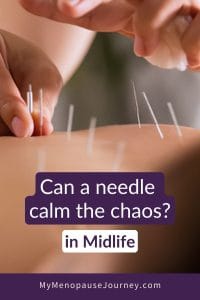
Table of Contents
Benefits of Acupuncture for Menopause: Why Midlife Women Are Turning to It
Acupuncture is an ancient healing practice that uses ultra-thin needles to stimulate specific points on the body. It’s been around for thousands of years, but modern midlife women are reaching for it because it’s surprisingly soothing!
Here’s the part that surprised me. The best modern explanation isn’t really about mysterious energy lines. It’s about your nervous system. Those tiny needles seem to nudge your body out of “fight or flight” and into “rest and digest” — quieting the revved-up stress response, and that steady drip of cortisol, that runs so hot in midlife. That’s the thread running through almost everything below.
Hormonal Mayhem? What Acupuncture Can (and Can’t) Do
Let me be honest with you, because this matters: acupuncture does not top up your estrogen or reset your progesterone. A needle doesn’t change your hormone levels. What it can do is calm the nervous system that your shifting hormones keep poking — so the hot flashes, the mood swings, the wired-but-exhausted feeling may ease, not because your hormones changed, but because your body stopped reacting to them quite so hard.
On hot flashes specifically, the research is genuinely mixed. Acupuncture reliably beats doing nothing — but when studies compare it to a “pretend” version, the gap narrows, which tells us a lot of the magic is the deep relaxation itself. And you know what? If you’re finally sleeping through the night, I’m not going to argue with you about why.
Stress and Tension, Meet Your Match
Life in midlife can feel like you’re juggling a dozen things at once — work, family, maybe aging parents, and all the rest. It’s easy to feel like you’re running on empty, isn’t it?
This is where acupuncture really earns its keep. You lie still, you get needled, and your body slides toward that “rest and digest” mode — heart rate settles, shoulders drop, and the revved-up stress response starts to quiet. If “tired but wired” is your default setting, that pause is exactly the kind of reset your overworked stress system has been begging for.
Tossing, Turning, Staring at the Ceiling? Acupuncture Can Help Here
This is one of acupuncture’s quiet wins — and the research here is actually pretty encouraging. Women getting acupuncture tend to fall asleep faster, wake less in the night, and feel more rested, with the benefit holding up weeks later. It calms that 2am racing mind so the kind of deep sleep you’ve been missing can finally show up. No tossing, no ceiling-staring — just rest.
Ache No More: How Acupuncture Eases Pain
Those nagging aches and pains you can’t seem to shake? If I had to pick acupuncture’s strongest card, it’s this one. For long-running pain — stiff joints, a cranky lower back, those tension headaches — the evidence is genuinely solid. Big, careful studies show acupuncture eases chronic pain better than no treatment, and the relief tends to stick around for months — not just the afternoon of your appointment. It seems to settle the pain signals themselves and support healthy circulation, giving sore spots a real chance to calm down.
Energy Slumps: A Gentler Way Back Up
Now, acupuncture isn’t a shot of espresso — it won’t hand you energy out of thin air. But here’s what happens: when you’re sleeping better and your stress dial finally turns down, that bone-deep tiredness starts to lift on its own. So instead of reaching for the third coffee to paper over the crash, you’ve actually got a bit more in the tank — energy that comes from your body finding its footing again. No jitters, no 3pm nosedive.
Bloating and Digestive Woes? Acupuncture Can Take the Edge Off
Let me be straight with you here, because this is where acupuncture gets oversold: it is not a weight-loss treatment. Anyone promising that with a needle is fibbing. What it may help with is the stuff around the edges — a calmer nervous system can mean less stress-driven snacking and a gut that isn’t quite so clenched, so that bloated, sluggish feeling can ease. But if weight is what’s really on your mind, the heavy lifting still happens on your plate and with your muscles — a protein target that actually fits midlife will move the needle far more than any needle will. Acupuncture is a gentle helper here, not the main event.
💡 Bottom line: acupuncture works mostly by talking to your nervous system, not your hormones. It turns down the stress response, eases pain, and helps you sleep — and when those three settle, a surprising amount of other stuff quietly improves on its own.
FAQs About Acupuncture
Does it hurt?
Most women barely feel the needles. They’re so fine that many describe the sensation as a light tap — or nothing at all.
Is it safe?
Very — when you go to a licensed, properly trained practitioner using single-use sterile needles. One thing worth doing: give them a heads-up if you’re pregnant, on blood thinners, or have a bleeding or clotting condition, so they can adjust your treatment.
How is it different from acupressure?
Acupuncture uses very thin needles. Acupressure uses gentle pressure — usually from fingers, palms, or special tools — on the same points. Both aim to support your body’s natural calming response, but acupuncture tends to be more targeted, while acupressure is a gentler option you can even try at home.
Take This With You…
Midlife isn’t about “losing your spark” — it’s about finding new ways to feed it.
Acupuncture for menopause won’t fix everything — but for sleep, pain, and a nervous system stuck on high alert, it’s a gentle, well-studied tool worth a try. And it plays beautifully with the things that already calm you — a daily walk, some gentle yoga, a few minutes of slow breathing or meditation, even a bit of journaling. Stack the quiet practices and they add up. Often the benefits unfold gradually, too, turning up in corners you weren’t even targeting — calmer moods, easier digestion, fewer headaches — because you’re helping your body feel safe and settled instead of chasing one symptom at a time.
And I’ll be straight with you, because that’s how we do things here: I haven’t tried acupuncture myself — it’s not part of my own routine. But in years of reading and studying menopause, I’ve watched plenty of women find real relief from it. So I’m not nudging you toward the table. I’m just laying out what’s on offer — and trusting you to pick what suits you best.
So if you’ve been curious, maybe it’s time to lie back, breathe deep, and let a few tiny needles help your body remember how to settle.
And if you’re not even sure which of your symptoms are hormones talking, start here: my free 5-Minute Menopause Map helps you name what’s actually going on — so you know where a tool like acupuncture fits, and where to look elsewhere.
References:
Acupuncture for chronic pain: individual patient data meta-analysis – PubMed (pubmed.ncbi.nlm.nih.gov)
Acupuncture for menopausal insomnia: a systematic review and meta-analysis – PMC (pmc.ncbi.nlm.nih.gov)
Acupuncture for menopausal hot flushes (Cochrane review) – Cochrane Library (cochranelibrary.com)
Acupuncture and women’s reproductive health: an overview – PMC (pmc.ncbi.nlm.nih.gov)
Acupuncture: Effectiveness and Safety – NCCIH (nccih.nih.gov)
Evidence on acupuncture therapies in clinical practice and health policy – The BMJ (bmj.com)

Written by Gita — Certified Fasting Therapist, Nutrition Coach and Keto Coach, and founder of My Menopause Journey since 2014. Every article is built on published research and trusted health sources, updated regularly, and shaped by her own journey through menopause. Read more about Gita and her credentials.